It helps you nothing, it is virtually the same as Nano or Uno.
I tried to understand this program but it's too complicated.
I hope it was translated correctly.
I'm from the Czech Republic
I am surprised that no one has yet pointed out to you before, but you can't power that many LEDs from the USB port. You need an external power supply.
Each LED can take a maximum of 60mA when lit fully (white). Even LEDs when not lit at all will take 1mA each.
So for 96 LEDs you would need 96 * 60 = 5.76 Amps.
If the LEDs only showed one of the additive primary colours (Red Green or Blue) you would require:-
96 * 20 = 1.92 Amps.
So you need an external power supply for this. Remember you need to connect the ground of the external supply to the ground of your Arduino.
So as well as running out of memory you are running out of power. I would recommend you get an Arduino with more memory like the Mega.
Your cide can be halved with same functionality if you would split the vux codes in parts (record audio, process audio, calculate led pattern, send led pattern.
For 96 leds you will always need 288 bytes of free ram on top of the report given be the compiler. But that should be possible with 2k of ram in the nano.
I remember this sketch from a few years ago... how and why this bad idea stays alive? It uses FastLED and Adafruit_Neopixel. Everything can be done with either library with a little "porting"... and a lot of memory saving.
Sketch uses 21658 bytes (70%) of program storage space. Maximum is 30720 bytes.
Global variables use 1765 bytes (86%) of dynamic memory, leaving 283 bytes for local variables. Maximum is 2048 bytes.
How does this sketch even work?
const int buttonPin = 0;
This must be useless... analog potentiometer on a digital pin? (see Post #31)
#define POT_PIN 4 // probably A4 (POT_PIN) with A5 (MIC_PIN)
You can save some memory here...
If your lack of memory is only allowing 72 WS2812, change this to 72... save 16 bytes.
// #define N_PIXELS  96  // Number of pixels in strand
#define N_PIXELS  72
This is never used... removing it saves no memory.
// Modes
enum
{
} MODE;
Never used...
bool paused = false;
bool boring = true;
bool gReverseDirection = false;
int diff;
This is defined twice...
#define LAST_PIXEL_OFFSET N_PIXELS-1
How to cause confusion...
#define maxsteps 16    // Case statement wouldn't allow a variable. // THIS HAS NO EFFECT
int maxSteps = 16; // this one is not used.

int color;
uint8_t colour;
This is never used, so always compiles the same way (the else)... (no bytes saved)
#ifdef CENTERED
Using the F() macro at every Serial.print() and Serial.println() loses 22 bytes of program storage, but gains 100 bytes of dynamic storage.
Button is wired active HIGH. Changing to active LOW (with button wiring) works, too.
if (buttonState == HIGH) {
This is never used...
// #include <SoftwareSerial.h>
These is never called... probably optimized-out...
 void setAll(byte red, byte green, byte blue) {
   for (int i = 0; i < N_PIXELS; i++) {
     setPixel(i, red, green, blue);
   }
   strip.show();
 }
Never used...
#define BG 0 // not used
Never used...
uint32_t* segmentAndResize(uint32_t* draw) {
  int seg_len = N_PIXELS / SEGMENTS;
  uint32_t segmented[N_PIXELS];
  for (int s = 0; s < SEGMENTS; s++) {
    for (int i = 0; i < seg_len; i++) {
      segmented[i + (s * seg_len)] = draw[map(i, 0, seg_len, 0, DRAW_MAX)];
    }
  }
  return segmented;
}
These caused warnings with FastLED... never used... probably optimized out...
// background color
 uint32_t currentBg = random(256);
 uint32_t nextBg = currentBg;
buttonPushCounter was used for switch(case) then set again to the same value... probably optimized-out... same with the unnecessary braces.
 switch (buttonPushCounter) {
    case 1:
      // buttonPushCounter == 1;
      // {
      All2();  // NORMAL
      break;
    // }
    case 2:
      // buttonPushCounter == 2;
      // {
      vu();  // NORMAL
      break;
    // }
    case 3:
      // buttonPushCounter == 3;
      // {
      vu1();  // Centre out
      break;
    // }
    case 4:
      // buttonPushCounter == 4;
      // {
      vu2();  // Centre Inwards
      break;
    // }
    case 5:
      // buttonPushCounter == 5;
      // {
      Vu3();  // Normal Rainbow
      break;
    // }
    case 6:
      // buttonPushCounter == 6;
      // {
      Vu4();  // Centre rainbow
      break;
    // }
    case 7:
      // buttonPushCounter == 7;
      // {
      Vu5();  // Shooting Star
      break;
    // }
    case 8:
      // buttonPushCounter == 8;
      // {
      Vu6();  // Falling star
      break;
    // }
    case 9:
      // buttonPushCounter == 9;
      // {
      vu7();  // Ripple with background
      break;
    // }
    case 10:
      // buttonPushCounter == 10;
      // {
      vu8();  // Shatter
      break;
    // }
    case 11:
      // buttonPushCounter == 11;
      // {
      vu9();  // Pulse
      break;
    // }
    case 12:
      // buttonPushCounter == 12;
      // {
      vu10();  // stream
      break;
    // }
    case 13:
      // buttonPushCounter == 13;
      // {
      vu11();  // Ripple without Background
      break;
    // }
    case 14:
      // buttonPushCounter == 14;
      // {
      vu12();  // Ripple without Background
      break;
    // }
    case 15:
      // buttonPushCounter == 15;
      // {
      vu13();  // Ripple without Background
      break;
    // }
    case 16:
      // buttonPushCounter == 16;
      // {
      colorWipe(strip.Color(0, 0, 0), 10);  // Black
      break;
      // }
  }
Local variables not used in loop()
  // uint8_t i;
  // uint16_t minLvl, maxLvl;
  // int n, height; // local variables not used here
This function is never used...
void writeToStrip(uint32_t* draw) {
  for (int i = 0; i < N_PIXELS; i++) {
    strip.setPixelColor(i, draw[i]);
  }
  strip.show();
}
Never used...
static uint16_t dist;     // A random number for noise generator__Náhodné číslo pro generátor šumu
dist = random16(12345);  // A semi-random number for our noise generator

uint16_t loops = 0;      // Our loops per second counter.
bool samplepeak = 0;     // This sample is well above the average, and is a 'peak'.
uint16_t oldsample = 0;  // Previous sample is used for peak detection and for 'on the fly' values.
bool thisdir = 0;
bool reverse = true;
float fadeRate = 0.80;
Three of these "do nothing" switch/cases...
    case maxsteps:  // At the end of the ripples.
      // step = -1;
      break;
"curve" is hard coded as "2"... these two lines are not needed...
  if (curve > 10) curve = 10;
  if (curve < -10) curve = -10;
This reference is never used... the schematic does not use AREF pin... (removing it decreases memory usage from 80% to 70%)
analogReference(EXTERNAL);
This library is also not used...
#include <math.h>
Saved a few bytes... (from 80% usage to 70% usage)
Sketch uses 21496 bytes (69%) of program storage space. Maximum is 30720 bytes.
Global variables use 1657 bytes (80%) of dynamic memory, leaving 391 bytes for local variables. Maximum is 2048 bytes.
A microphone and the Arduino 10-bit A/D don't have a higher resolution than 60 db.
Not sure why you want a 96 LED display if you can't hear/measure more than 50-60 steps.
More LEDs will just display noise (always on).
Leo..
Pffff... Ok first of all, Use only 1 library and buffer to control the LEDS
   #include <Adafruit_NeoPixel.h>
    #include <FastLED.h>
    struct CRGB leds[N_PIXELS];
    Adafruit_NeoPixel strip = Adafruit_NeoPixel(N_PIXELS, LED_PIN, NEO_GRB + NEO_KHZ800);
This is just wasting memory and serves no actual purpose also since the same output pin is being used.
For most of the code you appear to be using adafruit_neopixel, until here
void ripple3() {
  for (int i = 0; i < N_PIXELS; i++) leds[i] = CHSV(bgcol, 255, sampleavg*2);  // Set the background colour.
Where all of a sudden FastLED is being used and then later on some more, it is just a complete mish-mash.
Decide which library you want to use. If you want to use FastLED functions and effect, get rid of the adafruit_neopixel and re-write the code so that the tasks it was performing are done with FastLED or vice versa.
I am a bit shocked that in a 26 post thread, nobody has mentioned this.
Also, really, clean up the code.
From ?
The code is terrible and that it works at all is strange. It looks like 2 combined codes thrown together.
The whole code should probably be completely re-written and optimized.
Normally speaking one would have different functions to generate different LED patterns into the output buffer and then call .show() from one spot in loop()
With the USB port providing 500mA i would say you need more power, but you have been reducing the brightness through the code i think, though hard to tell with both libraries being used.
To be really honest: I did not feel the urge to dig any deeper... ...from the surface it was already clear that it was very unlikely that OP had made this himself and/or did understand the code...
Hi, @jiri2025
Welcome to the forum.
Can you please post a link to where you got the code?
Can you please post a copy of your circuit, a picture of a hand drawn circuit in jpg, png?
Hand drawn and photographed is perfectly acceptable.
Please include ALL hardware, power supplies, component names and pin labels.
From the LED link;
Let's Know how to Choose Led Power
Calculated The Whole Led Strip Watts:
1.One Led Chip is About 0.2W,If You Buy is 5m 30Leds/m(Total Led Strip is 150Leds) ,So 0.2W*150=30W
2.And This Led Strip Work 5V,So 30W / 5V=6A,We Know This Led Strip Better at Least 6A......
Have you calculated the amount of power your strip will require?
Do you have one strip or two, for stereo?
Tom.... 


Just lately i have been a bit puzzled by this.
That is what i have been using to calculate as well, until recently i was confronted with WS2812C (basically WS2812b in 2020 package) and was given to understand that the maximum current for those was 15mA or so (makes sense, smaller chip, less light, less power) and then while building a 32x80 ledmatrix using the 5050 package i started to look at how much i needed and 'somewhere' i found that they were rated to use no more than 36mA.
Still an awful lot, For 2560 pixels that ends up being 92.16A, which is 450Watts. Now i didn't have more than 90A PSU (actually a 30A & a 60A) available and i used that, since i am anyway just using it for testing, but it actually seems to suffice just fine even with all pixels flashing 'WHITE'
So i know i am going a tad of topic here, but is there a chance that newer WS2812b chips are using less power than older ones ? (i know there is differences in brightness, some rings i bought are significantly brighter than some of the strip i have)
It is abundantly clear however that the OP needs to use something else than the USB power to power 96 pixels, even with lower brightness and not using all colors at once (white)
To be honest, when analogRead() called just to 4 as pin number - it automatically changed D4 to A4
My experience is that you will almost never need the calculated max. current. It really is blinding bright...
Unless you use the strips as illumination... but then a 12V version is more economical and easier as the currents will be far smaller.
With some libraries you can set the max brightness. If you set that to 64 your max power goes down by a factor of 4!
One of the contributors is Andrew Tuline who has online accounts
- website https://tuline.com/
- atuline (Andrew Tuline) · GitHub
- https://www.youtube.com/user/atuline/videos
- vumeter mention of @Andrew_Tuline on https://forum.makerforums.info/
- Atuline's Pastebin - Pastebin.com
This seems to be where some of the redundant code comes from (16 pushbutton cases, height, peak, "centered", Adafruit AND FastLED)
Their schematic

The original code remains but is commented-out and amended where needed.
This code uses 72 WS2812. Any more will cause memory problems again.
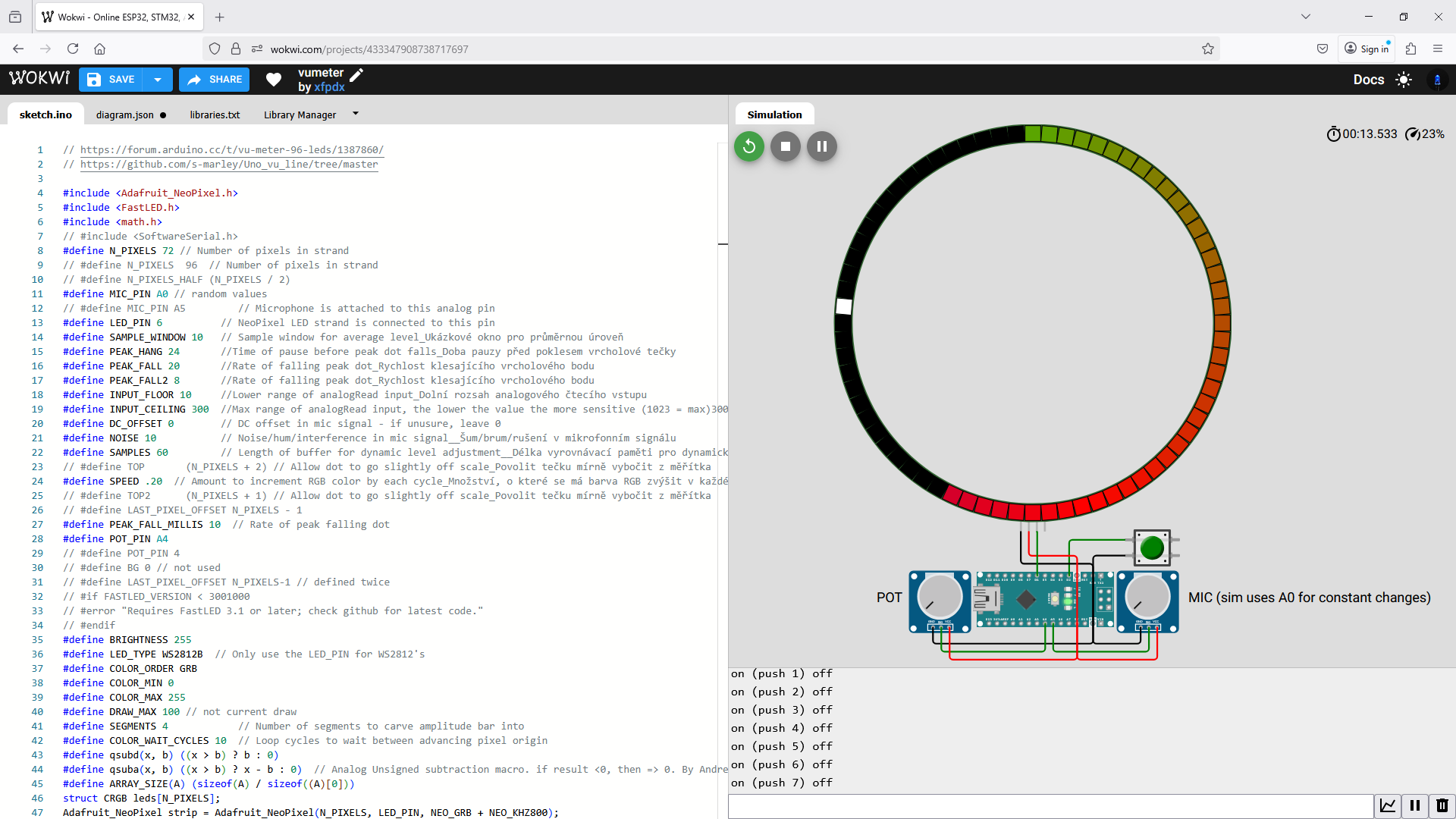
I "wired" the simulation (below) with A5 to the "MIC" but the sim reads A0 to provide a constant, changing value for the "VU" to move.
Although the code says "four segments," the presentation is not fluid on four segments (cascaded). I left it on a "ring" of 72.
Post #25 shows the easily-fixed memory issues, compiled from this result (including FastLED warnings):
Sketch uses 21658 bytes (70%) of program storage space. Maximum is 30720 bytes.
Global variables use 1765 bytes (86%) of dynamic memory, leaving 283 bytes for local variables. Maximum is 2048 bytes.
... to this result, with no warnings...
Sketch uses 21496 bytes (69%) of program storage space. Maximum is 30720 bytes.
Global variables use 1657 bytes (80%) of dynamic memory, leaving 391 bytes for local variables. Maximum is 2048 bytes.
The sketch is responsive and button presses roll over sequence 16 to sequence 1 (not 2 as before).
Wire the button from PIN >> BUTTON (N.O.) >> BUTTON (N.O.) >> GND and configure it for INPUT_PULLUP
I do not understand enough about passing multi-dimension arguments or structures, so I did not attempt to create the few FastLED (or many Adafruit_NeoPixel) functions to remove one of the two libraries. I will try to change the Adafruit functions to FastLED rather than the other way because Adafruit seems the easier library.
I do not want to clutter my wokwi account with this code, so I am just posting the working code and the Wokwi diagram.json
@jiri2025 - This works. Re-wire your button for INPUT_PULLUP. Use only 72 neopixel. Properly power this or you will destroy your Arduino.
// https://forum.arduino.cc/t/vu-meter-96-leds/1387860/
// https://github.com/s-marley/Uno_vu_line/tree/master

#include <Adafruit_NeoPixel.h>
#include <FastLED.h>
// #include <math.h>
// #include <SoftwareSerial.h>
#define N_PIXELS 72 // Number of pixels in strand
// #define N_PIXELS  96  // Number of pixels in strand
// #define N_PIXELS_HALF (N_PIXELS / 2)
#define MIC_PIN A0 // random values
// #define MIC_PIN A5         // Microphone is attached to this analog pin
#define LED_PIN 6          // NeoPixel LED strand is connected to this pin
#define SAMPLE_WINDOW 10   // Sample window for average level_Ukázkové okno pro průměrnou úroveň
#define PEAK_HANG 24       //Time of pause before peak dot falls_Doba pauzy před poklesem vrcholové tečky
#define PEAK_FALL 20       //Rate of falling peak dot_Rychlost klesajícího vrcholového bodu
#define PEAK_FALL2 8       //Rate of falling peak dot_Rychlost klesajícího vrcholového bodu
#define INPUT_FLOOR 10     //Lower range of analogRead input_Dolní rozsah analogového čtecího vstupu
#define INPUT_CEILING 300  //Max range of analogRead input, the lower the value the more sensitive (1023 = max)300 (150)
#define DC_OFFSET 0        // DC offset in mic signal - if unusure, leave 0
#define NOISE 10           // Noise/hum/interference in mic signal__Šum/brum/rušení v mikrofonním signálu
#define SAMPLES 60         // Length of buffer for dynamic level adjustment__Délka vyrovnávací paměti pro dynamické nastavení úrovně
// #define TOP       (N_PIXELS + 2) // Allow dot to go slightly off scale_Povolit tečku mírně vybočit z měřítka
#define SPEED .20  // Amount to increment RGB color by each cycle_Množství, o které se má barva RGB zvýšit v každém cyklu
// #define TOP2      (N_PIXELS + 1) // Allow dot to go slightly off scale_Povolit tečku mírně vybočit z měřítka
// #define LAST_PIXEL_OFFSET N_PIXELS - 1
#define PEAK_FALL_MILLIS 10  // Rate of peak falling dot
#define POT_PIN A4
// #define POT_PIN 4
// #define BG 0 // not used
// #define LAST_PIXEL_OFFSET N_PIXELS-1 // defined twice
// #if FASTLED_VERSION < 3001000
// #error "Requires FastLED 3.1 or later; check github for latest code."
// #endif
#define BRIGHTNESS 255
#define LED_TYPE WS2812B  // Only use the LED_PIN for WS2812's
#define COLOR_ORDER GRB
#define COLOR_MIN 0
#define COLOR_MAX 255
#define DRAW_MAX 100 // not current draw
#define SEGMENTS 4            // Number of segments to carve amplitude bar into
#define COLOR_WAIT_CYCLES 10  // Loop cycles to wait between advancing pixel origin
#define qsubd(x, b) ((x > b) ? b : 0)
#define qsuba(x, b) ((x > b) ? x - b : 0)  // Analog Unsigned subtraction macro. if result <0, then => 0. By Andrew Tuline.
#define ARRAY_SIZE(A) (sizeof(A) / sizeof((A)[0]))
struct CRGB leds[N_PIXELS];
Adafruit_NeoPixel strip = Adafruit_NeoPixel(N_PIXELS, LED_PIN, NEO_GRB + NEO_KHZ800);
// static uint16_t dist;     // NEVER USED A random number for noise generator__Náhodné číslo pro generátor šumu
uint16_t scale = 30;      // Wouldn't recommend changing this on the fly, or the animation will be really blocky.
uint8_t maxChanges = 48;  // Value for blending between palettes.
CRGBPalette16 currentPalette(OceanColors_p);
CRGBPalette16 targetPalette(CloudColors_p);
//new ripple vu__nové zvlnění vu
uint8_t timeval = 20;    // Currently 'delay' value. No, I don't use delays, I use EVERY_N_MILLIS_I instead.
// uint16_t loops = 0;      // Our loops per second counter.
// bool samplepeak = 0;     // This sample is well above the average, and is a 'peak'.
// uint16_t oldsample = 0;  // Previous sample is used for peak detection and for 'on the fly' values.
// bool thisdir = 0;
//new ripple vu_nové zvlnění vu
// // Modes
// enum
// {
// } MODE;
// bool reverse = true; // not used
int BRIGHTNESS_MAX = 80;
int brightness = 20;
byte
//  peak      = 0,      // Used for falling dot
//  dotCount  = 0,      // Frame counter for delaying dot-falling speed
volCount = 0;  // Frame counter for storing past volume data
int
reading,
vol[SAMPLES],   // Collection of prior volume samples
lvl = 10,       // Current "dampened" audio level
minLvlAvg = 0,  // For dynamic adjustment of graph low & high
maxLvlAvg = 512;
float
greenOffset = 30,
blueOffset = 150;
// cycle variables
int CYCLE_MIN_MILLIS = 2;
int CYCLE_MAX_MILLIS = 1000;
int cycleMillis = 20;
// bool paused = false; // not used
long lastTime = 0;
// bool boring = true; // not used
// bool gReverseDirection = false; // not used
int myhue = 0;
//vu ripple
uint8_t colour;
uint8_t myfade = 255;  // Starting brightness.
#define maxsteps 16    // Case statement wouldn't allow a variable.
int peakspersec = 0;
int peakcount = 0;
uint8_t bgcol = 0;
int thisdelay = 20;
uint8_t max_bright = 255;
unsigned int sample;
//Samples_Vzorky
#define NSAMPLES 64
unsigned int samplearray[NSAMPLES];
unsigned long samplesum = 0;
unsigned int sampleavg = 0;
int samplecount = 0;
//unsigned int sample = 0; // previously defined
unsigned long oldtime = 0;
unsigned long newtime = 0;
//Ripple variables
int color;
int center = 0;
int step = -1;
// int maxSteps = 16; // this is not used
// float fadeRate = 0.80; // not used
// int diff; // not used
//vu 8 variables
int
origin = 0,
color_wait_count = 0,
scroll_color = COLOR_MIN,
last_intensity = 0,
intensity_max = 0,
origin_at_flip = 0;
uint32_t
draw[DRAW_MAX];
boolean
growing = false,
fall_from_left = true;
// background color
// uint32_t currentBg = random(256);
// uint32_t nextBg = currentBg;
TBlendType currentBlending; // FastLED
const int buttonPin = 2;  // the number of the pushbutton pin__číslo kolíku tlačítka
// const int buttonPin = 0;  // the number of the pushbutton pin__číslo kolíku tlačítka
//Variables will change:
int buttonPushCounter = 0;  // counter for the number of button presses
int buttonState = 0;        // current state of the button
int lastButtonState = 0;
byte peak = 16;  // Peak level of column; used for falling dots
//    unsigned int sample; // previously defined
byte dotCount = 0;      //Frame counter for peak dot
byte dotHangCount = 0;  //Frame counter for holding peak dot

void setup() {
  // analogReference(EXTERNAL);
  pinMode(buttonPin, INPUT_PULLUP);
  // pinMode(buttonPin, INPUT);
  //initialize the buttonPin as output
  digitalWrite(buttonPin, HIGH);
  strip.begin();
  strip.show();  // all pixels to 'off'
  Serial.begin(115200);
  // Serial.begin(57600);
  // Serial.begin(9600);
  // delay(3000); // why?
  LEDS.addLeds<LED_TYPE, LED_PIN, COLOR_ORDER>(leds, N_PIXELS).setCorrection(TypicalLEDStrip);
  LEDS.setBrightness(BRIGHTNESS);
  // dist = random16(12345);  // A semi-random number for our noise generator
}
float fscale(float originalMin, float originalMax, float newBegin, float newEnd, float inputValue, float curve) {
  float OriginalRange = 0;
  float NewRange = 0;
  float zeroRefCurVal = 0;
  float normalizedCurVal = 0;
  float rangedValue = 0;
  boolean invFlag = 0;

  // condition curve parameter__parametr křivky stavu
  // limit range__limitní rozsah

  // "curve" is hard coded as "2"... these two lines are not needed...
  // if (curve > 10)
  //    curve = 10;
  // if (curve < -10)
  //    curve = -10;

  curve = (curve * -.1);   // - invert and scale - this seems more intuitive - postive numbers give more weight to high end on output
  curve = pow(10, curve);  // convert linear scale into lograthimic exponent for other pow function
  // Check for out of range inputValues
  if (inputValue < originalMin) {
    inputValue = originalMin;
  }
  if (inputValue > originalMax) {
    inputValue = originalMax;
  }
  // Zero Refference the values
  OriginalRange = originalMax - originalMin;
  if (newEnd > newBegin) {
    NewRange = newEnd - newBegin;
  } else {
    NewRange = newBegin - newEnd;
    invFlag = 1;
  }
  zeroRefCurVal = inputValue - originalMin;
  normalizedCurVal = zeroRefCurVal / OriginalRange;  // normalize to 0 - 1 float
  // Check for originalMin > originalMax  - the math for all other cases i.e. negative numbers seems to work out fine
  if (originalMin > originalMax) {
    return 0;
  }
  if (invFlag == 0) {
    rangedValue = (pow(normalizedCurVal, curve) * NewRange) + newBegin;
  } else  // invert the ranges
  {
    rangedValue = newBegin - (pow(normalizedCurVal, curve) * NewRange);
  }
  return rangedValue;
}

void loop() {
  //for mic
  // uint8_t i;
  // uint16_t minLvl, maxLvl;
  // int n, height; // local variables not used here
  // end mic
  // read the pushbutton input pin:
  buttonState = digitalRead(buttonPin);
  // compare the buttonState to its previous state
  if (buttonState != lastButtonState) {
    // if the state has changed, increment the counter
    if (buttonState == LOW) { // change to ACTIVE LOW button
      // if (buttonState == HIGH) {
      // if the current state is HIGH then the button wend from off to on:
      buttonPushCounter++;
      if (buttonPushCounter > 16)
        buttonPushCounter = 1;
      Serial.print(F("on"));
      // Serial.println(F("on"));
      Serial.print(F(" (push "));
      // Serial.print(F("number of button pushes:  "));
      Serial.print(buttonPushCounter);
      Serial.print(F(") "));
      // if (buttonPushCounter == 16) // moved to above, after buttonPushCounter increment
      //   buttonPushCounter = 1;
    } else {
      // if the current state is LOW then the button
      // wend from on to off:
      Serial.println(F("off"));
    }
  }

  // save the current state as the last state,
  //for next time through the loop
  lastButtonState = buttonState;
  switch (buttonPushCounter) {
    case 1:
      // buttonPushCounter == 1;
      // {
      All2();  // NORMAL
      break;
    // }
    case 2:
      // buttonPushCounter == 2;
      // {
      vu();  // NORMAL
      break;
    // }
    case 3:
      // buttonPushCounter == 3;
      // {
      vu1();  // Centre out
      break;
    // }
    case 4:
      // buttonPushCounter == 4;
      // {
      vu2();  // Centre Inwards
      break;
    // }
    case 5:
      // buttonPushCounter == 5;
      // {
      Vu3();  // Normal Rainbow
      break;
    // }
    case 6:
      // buttonPushCounter == 6;
      // {
      Vu4();  // Centre rainbow
      break;
    // }
    case 7:
      // buttonPushCounter == 7;
      // {
      Vu5();  // Shooting Star
      break;
    // }
    case 8:
      // buttonPushCounter == 8;
      // {
      Vu6();  // Falling star
      break;
    // }
    case 9:
      // buttonPushCounter == 9;
      // {
      vu7();  // Ripple with background
      break;
    // }
    case 10:
      // buttonPushCounter == 10;
      // {
      vu8();  // Shatter
      break;
    // }
    case 11:
      // buttonPushCounter == 11;
      // {
      vu9();  // Pulse
      break;
    // }
    case 12:
      // buttonPushCounter == 12;
      // {
      vu10();  // stream
      break;
    // }
    case 13:
      // buttonPushCounter == 13;
      // {
      vu11();  // Ripple without Background
      break;
    // }
    case 14:
      // buttonPushCounter == 14;
      // {
      vu12();  // Ripple without Background
      break;
    // }
    case 15:
      // buttonPushCounter == 15;
      // {
      vu13();  // Ripple without Background
      break;
    // }
    case 16:
      // buttonPushCounter == 16;
      // {
      colorWipe(strip.Color(0, 0, 0), 10);  // Black
      break;
      // }
  }
}

void colorWipe(uint32_t c, uint8_t wait) {
  for (uint16_t i = 0; i < strip.numPixels(); i++) {
    strip.setPixelColor(i, c);
    strip.show();
    if (digitalRead(buttonPin) != lastButtonState)  // <------------- add this
      return;                                       // <------------ and this
    delay(wait);
  }
}

void vu() {
  uint8_t i;
  uint16_t minLvl, maxLvl;
  int n, height;
  n = analogRead(MIC_PIN);             // Raw reading from mic
  n = abs(n - 512 - DC_OFFSET);        // Center on zero
  n = (n <= NOISE) ? 0 : (n - NOISE);  // Remove noise/hum
  lvl = ((lvl * 7) + n) >> 3;          // "Dampened" reading (else looks twitchy)
  // Calculate bar height based on dynamic min/max levels (fixed point):
  height = (N_PIXELS + 2) * (lvl - minLvlAvg) / (long)(maxLvlAvg - minLvlAvg);
  if (height < 0L) height = 0;  // Clip output
  else if (height > (N_PIXELS + 2)) height = (N_PIXELS + 2);
  if (height > peak) peak = height;  // Keep 'peak' dot at top
  // Color pixels based on rainbow gradient
  for (i = 0; i < N_PIXELS; i++) {
    if (i >= height) strip.setPixelColor(i, 0, 0, 0);
    else strip.setPixelColor(i, Wheel(map(i, 0, strip.numPixels() - 1, 30, 150)));
  }
  // Draw peak dot
  if (peak > 0 && peak <= N_PIXELS - 1)
    strip.setPixelColor(peak, Wheel(map(peak, 0, strip.numPixels() - 1, 30, 150)));
  strip.show();  // Update strip

  // Every few frames, make the peak pixel drop by 1:  // Každých pár snímků sníží počet pixelů o 1:
  if (++dotCount >= PEAK_FALL) {  //fall rate
    if (peak > 0) peak--;
    dotCount = 0;
  }

  vol[volCount] = n;                        // Save sample for dynamic leveling
  if (++volCount >= SAMPLES)
    volCount = 0;  // Advance/rollover sample counter

  // Get volume range of prior frames // Získání rozsahu hlasitosti předchozích snímků
  minLvl = maxLvl = vol[0];
  for (i = 1; i < SAMPLES; i++) {
    if (vol[i] < minLvl)
      minLvl = vol[i];
    else if (vol[i] > maxLvl)
      maxLvl = vol[i];
  }

  // minLvl and maxLvl indicate the volume range over prior frames, used
  // for vertically scaling the output graph (so it looks interesting
  // regardless of volume level).  If they're too close together though
  // (e.g. at very low volume levels) the graph becomes super coarse
  // and 'jumpy'...so keep some minimum distance between them (this
  // also lets the graph go to zero when no sound is playing):
  if ((maxLvl - minLvl) < (N_PIXELS + 2))
    maxLvl = minLvl + (N_PIXELS + 2);
  minLvlAvg = (minLvlAvg * 63 + minLvl) >> 6;  // Dampen min/max levels
  maxLvlAvg = (maxLvlAvg * 63 + maxLvl) >> 6;  // (fake rolling average)
}
// Input a value 0 to 255 to get a color value.
// The colors are a transition r - g - b - back to r.
uint32_t Wheel(byte WheelPos) {
  if (WheelPos < 85) {
    return strip.Color(WheelPos * 3, 255 - WheelPos * 3, 0);
  } else if (WheelPos < 170) {
    WheelPos -= 85;
    return strip.Color(255 - WheelPos * 3, 0, WheelPos * 3);
  } else {
    WheelPos -= 170;
    return strip.Color(0, WheelPos * 3, 255 - WheelPos * 3);
  }
}

void vu1() {
  uint8_t i;
  uint16_t minLvl, maxLvl;
  int n, height;
  n = analogRead(MIC_PIN);             // Raw reading from mic
  n = abs(n - 512 - DC_OFFSET);        // Center on zero
  n = (n <= NOISE) ? 0 : (n - NOISE);  // Remove noise/hum
  lvl = ((lvl * 7) + n) >> 3;          // "Dampened" reading (else looks twitchy)
  // Calculate bar height based on dynamic min/max levels (fixed point):
  height = (N_PIXELS + 2) * (lvl - minLvlAvg) / (long)(maxLvlAvg - minLvlAvg);
  if (height < 0L) height = 0;  // Clip output
  else if (height > (N_PIXELS + 2)) height = (N_PIXELS + 2);
  if (height > peak) peak = height;  // Keep 'peak' dot at top
  // Color pixels based on rainbow gradient
  for (i = 0; i < (N_PIXELS / 2); i++) {
    if (i >= height) {
      strip.setPixelColor((N_PIXELS / 2) - i - 1, 0, 0, 0);
      strip.setPixelColor((N_PIXELS / 2) + i, 0, 0, 0);
    } else {
      uint32_t color = Wheel(map(i, 0, (N_PIXELS / 2) - 1, 30, 150));
      strip.setPixelColor((N_PIXELS / 2) - i - 1, color);
      strip.setPixelColor((N_PIXELS / 2) + i, color);
    }
  }
  // Draw peak dot
  if (peak > 0 && peak <= (N_PIXELS / 2) - 1) {
    uint32_t color = Wheel(map(peak, 0, (N_PIXELS / 2) - 1, 30, 150));
    strip.setPixelColor((N_PIXELS / 2) - peak - 1, color);
    strip.setPixelColor((N_PIXELS / 2) + peak, color);
  }
  strip.show();  // Update strip

  // Every few frames, make the peak pixel drop by 1:
  if (++dotCount >= PEAK_FALL) {  //fall rate
    if (peak > 0) peak--;
    dotCount = 0;
  }

  vol[volCount] = n;                        // Save sample for dynamic leveling
  if (++volCount >= SAMPLES)
    volCount = 0;  // Advance/rollover sample counter

  // Get volume range of prior frames
  minLvl = maxLvl = vol[0];
  for (i = 1; i < SAMPLES; i++) {
    if (vol[i] < minLvl)
      minLvl = vol[i];
    else if (vol[i] > maxLvl)
      maxLvl = vol[i];
  }

  // minLvl and maxLvl indicate the volume range over prior frames, used
  // for vertically scaling the output graph (so it looks interesting
  // regardless of volume level).  If they're too close together though
  // (e.g. at very low volume levels) the graph becomes super coarse
  // and 'jumpy'...so keep some minimum distance between them (this
  // also lets the graph go to zero when no sound is playing):
  if ((maxLvl - minLvl) < (N_PIXELS + 2))
    maxLvl = minLvl + (N_PIXELS + 2);
  minLvlAvg = (minLvlAvg * 63 + minLvl) >> 6;  // Dampen min/max levels
  maxLvlAvg = (maxLvlAvg * 63 + maxLvl) >> 6;  // (fake rolling average)
}

void vu2() {
  unsigned long startMillis = millis();  // Start of sample window
  float peakToPeak = 0;                  // peak-to-peak level
  unsigned int signalMax = 0;
  unsigned int signalMin = 1023;
  unsigned int c, y;
  while (millis() - startMillis < SAMPLE_WINDOW) {
    sample = analogRead(MIC_PIN);
    if (sample < 1024) {
      if (sample > signalMax) {
        signalMax = sample;
      } else if (sample < signalMin) {
        signalMin = sample;
      }
    }
  }
  peakToPeak = signalMax - signalMin;
  // Serial.println(peakToPeak);
  for (int i = 0; i <= (N_PIXELS / 2) - 1; i++) {
    uint32_t color = Wheel(map(i, 0, (N_PIXELS / 2) - 1, 30, 150));
    strip.setPixelColor(N_PIXELS - i, color);
    strip.setPixelColor(0 + i, color);
  }
  c = fscale(INPUT_FLOOR, INPUT_CEILING, (N_PIXELS / 2), 0, peakToPeak, 2);
  if (c < peak) {
    peak = c;          // Keep dot on top
    dotHangCount = 0;  // make the dot hang before falling
  }
  if (c <= strip.numPixels()) {  // Fill partial column with off pixels
    drawLine((N_PIXELS / 2), (N_PIXELS / 2) - c, strip.Color(0, 0, 0));
    drawLine((N_PIXELS / 2), (N_PIXELS / 2) + c, strip.Color(0, 0, 0));
  }
  y = (N_PIXELS / 2) - peak;
  uint32_t color1 = Wheel(map(y, 0, (N_PIXELS / 2) - 1, 30, 150));
  strip.setPixelColor(y - 1, color1);
  //strip.setPixelColor(y-1,Wheel(map(y,0,(N_PIXELS/2)-1,30,150)));
  y = (N_PIXELS / 2) + peak;
  strip.setPixelColor(y, color1);
  //strip.setPixelColor(y+1,Wheel(map(y,0,(N_PIXELS/2)+1,30,150)));
  strip.show();
  // Frame based peak dot animation
  if (dotHangCount > PEAK_HANG) {    //Peak pause length
    if (++dotCount >= PEAK_FALL2) {  //Fall rate
      peak++;
      dotCount = 0;
    }
  } else {
    dotHangCount++;
  }
}

void Vu3() {
  uint8_t i;
  uint16_t minLvl, maxLvl;
  int n, height;
  n = analogRead(MIC_PIN);             // Raw reading from mic
  n = abs(n - 512 - DC_OFFSET);        // Center on zero
  n = (n <= NOISE) ? 0 : (n - NOISE);  // Remove noise/hum
  lvl = ((lvl * 7) + n) >> 3;          // "Dampened" reading (else looks twitchy)
  // Calculate bar height based on dynamic min/max levels (fixed point):
  height = (N_PIXELS + 2) * (lvl - minLvlAvg) / (long)(maxLvlAvg - minLvlAvg);
  if (height < 0L) height = 0;  // Clip output
  else if (height > (N_PIXELS + 2)) height = (N_PIXELS + 2);
  if (height > peak) peak = height;  // Keep 'peak' dot at top
  greenOffset += SPEED;
  blueOffset += SPEED;
  if (greenOffset >= 255) greenOffset = 0;
  if (blueOffset >= 255) blueOffset = 0;
  // Color pixels based on rainbow gradient
  for (i = 0; i < N_PIXELS; i++) {
    if (i >= height) {
      strip.setPixelColor(i, 0, 0, 0);
    } else {
      strip.setPixelColor(i, Wheel(map(i, 0, strip.numPixels() - 1, (int)greenOffset, (int)blueOffset)));
    }
  }
  // Draw peak dot
  if (peak > 0 && peak <= N_PIXELS - 1)
    strip.setPixelColor(peak, Wheel(map(peak, 0, strip.numPixels() - 1, 30, 150)));
  strip.show();  // Update strip

  // Every few frames, make the peak pixel drop by 1:
  if (++dotCount >= PEAK_FALL) {  //fall rate
    if (peak > 0) peak--;
    dotCount = 0;
  }
  // strip.show();  // Update strip // NOT NEEDED
  vol[volCount] = n;
  if (++volCount >= SAMPLES)
    volCount = 0;

  // Get volume range of prior frames
  minLvl = maxLvl = vol[0];
  for (i = 1; i < SAMPLES; i++) {
    if (vol[i] < minLvl)
      minLvl = vol[i];
    else if (vol[i] > maxLvl)
      maxLvl = vol[i];
  }

  // minLvl and maxLvl indicate the volume range over prior frames, used
  // for vertically scaling the output graph (so it looks interesting
  // regardless of volume level).  If they're too close together though
  // (e.g. at very low volume levels) the graph becomes super coarse
  // and 'jumpy'...so keep some minimum distance between them (this
  // also lets the graph go to zero when no sound is playing):
  if ((maxLvl - minLvl) < (N_PIXELS + 2))
    maxLvl = minLvl + (N_PIXELS + 2);
  minLvlAvg = (minLvlAvg * 63 + minLvl) >> 6;  // Dampen min/max levels
  maxLvlAvg = (maxLvlAvg * 63 + maxLvl) >> 6;  // (fake rolling average)
}

void Vu4() {
  uint8_t i;
  uint16_t minLvl, maxLvl;
  int n, height;
  n = analogRead(MIC_PIN);             // Raw reading from mic
  n = abs(n - 512 - DC_OFFSET);        // Center on zero
  n = (n <= NOISE) ? 0 : (n - NOISE);  // Remove noise/hum
  lvl = ((lvl * 7) + n) >> 3;          // "Dampened" reading (else looks twitchy)
  // Calculate bar height based on dynamic min/max levels (fixed point):
  height = (N_PIXELS + 2) * (lvl - minLvlAvg) / (long)(maxLvlAvg - minLvlAvg);
  if (height < 0L) height = 0;  // Clip output
  else if (height > (N_PIXELS + 2)) height = (N_PIXELS + 2);
  if (height > peak) peak = height;  // Keep 'peak' dot at top
  greenOffset += SPEED;
  blueOffset += SPEED;
  if (greenOffset >= 255) greenOffset = 0;
  if (blueOffset >= 255) blueOffset = 0;
  // Color pixels based on rainbow gradient
  for (i = 0; i < (N_PIXELS / 2); i++) {
    if (i >= height) {
      strip.setPixelColor((N_PIXELS / 2) - i - 1, 0, 0, 0);
      strip.setPixelColor((N_PIXELS / 2) + i, 0, 0, 0);
    } else {
      uint32_t color = Wheel(map(i, 0, (N_PIXELS / 2) - 1, (int)greenOffset, (int)blueOffset));
      strip.setPixelColor((N_PIXELS / 2) - i - 1, color);
      strip.setPixelColor((N_PIXELS / 2) + i, color);
    }
  }
  // Draw peak dot
  if (peak > 0 && peak <= (N_PIXELS / 2) - 1) {
    uint32_t color = Wheel(map(peak, 0, (N_PIXELS / 2) - 1, 30, 150));
    strip.setPixelColor((N_PIXELS / 2) - peak - 1, color);
    strip.setPixelColor((N_PIXELS / 2) + peak, color);
  }
  strip.show();  // Update strip
  // Every few frames, make the peak pixel drop by 1:
  if (++dotCount >= PEAK_FALL) {  //fall rate
    if (peak > 0) peak--;
    dotCount = 0;
  }

  vol[volCount] = n;                        // Save sample for dynamic leveling
  if (++volCount >= SAMPLES)
    volCount = 0;  // Advance/rollover sample counter

  // Get volume range of prior frames
  minLvl = maxLvl = vol[0];
  for (i = 1; i < SAMPLES; i++) {
    if (vol[i] < minLvl)
      minLvl = vol[i];
    else if (vol[i] > maxLvl)
      maxLvl = vol[i];
  }

  // minLvl and maxLvl indicate the volume range over prior frames, used
  // for vertically scaling the output graph (so it looks interesting
  // regardless of volume level).  If they're too close together though
  // (e.g. at very low volume levels) the graph becomes super coarse
  // and 'jumpy'...so keep some minimum distance between them (this
  // also lets the graph go to zero when no sound is playing):
  if ((maxLvl - minLvl) < (N_PIXELS + 2))
    maxLvl = minLvl + (N_PIXELS + 2);
  minLvlAvg = (minLvlAvg * 63 + minLvl) >> 6;  // Dampen min/max levels
  maxLvlAvg = (maxLvlAvg * 63 + maxLvl) >> 6;  // (fake rolling average)
}

void Vu5() {
  uint8_t i;
  uint16_t minLvl, maxLvl;
  int n, height;
  n = analogRead(MIC_PIN);             // Raw reading from mic
  n = abs(n - 512 - DC_OFFSET);        // Center on zero
  n = (n <= NOISE) ? 0 : (n - NOISE);  // Remove noise/hum
  lvl = ((lvl * 7) + n) >> 3;          // "Dampened" reading (else looks twitchy)
  // Calculate bar height based on dynamic min/max levels (fixed point):
  height = (N_PIXELS + 1) * (lvl - minLvlAvg) / (long)(maxLvlAvg - minLvlAvg);
  if (height < 0L) height = 0;  // Clip output
  else if (height > (N_PIXELS + 1)) height = (N_PIXELS + 1);
  if (height > peak) peak = height;  // Keep 'peak' dot at top

  // #ifdef CENTERED
  //   // Color pixels based on rainbow gradient
  //   for (i = 0; i < (N_PIXELS / 2); i++) {
  //     if (((N_PIXELS / 2) + i) >= height) {
  //       strip.setPixelColor(((N_PIXELS / 2) + i), 0, 0, 0);
  //       strip.setPixelColor(((N_PIXELS / 2) - i), 0, 0, 0);
  //     } else {
  //       strip.setPixelColor(((N_PIXELS / 2) + i), Wheel(map(((N_PIXELS / 2) + i), 0, strip.numPixels() - 1, 30, 150)));
  //       strip.setPixelColor(((N_PIXELS / 2) - i), Wheel(map(((N_PIXELS / 2) - i), 0, strip.numPixels() - 1, 30, 150)));
  //     }
  //   }
  //   // Draw peak dot
  //   if (peak > 0 && peak <= (N_PIXELS - 1)) {
  //     strip.setPixelColor(((N_PIXELS / 2) + peak), 255, 255, 255);  // (peak,Wheel(map(peak,0,strip.numPixels()-1,30,150)));
  //     strip.setPixelColor(((N_PIXELS / 2) - peak), 255, 255, 255);  // (peak,Wheel(map(peak,0,strip.numPixels()-1,30,150)));
  //   }
  // #else

  // Color pixels based on rainbow gradient
  for (i = 0; i < N_PIXELS; i++) {
    if (i >= height) {
      strip.setPixelColor(i, 0, 0, 0);
    } else {
      strip.setPixelColor(i, Wheel(map(i, 0, strip.numPixels() - 1, 30, 150)));
    }
  }
  // Draw peak dot
  if (peak > 0 && peak <= (N_PIXELS - 1)) {
    strip.setPixelColor(peak, 255, 255, 255);  // (peak,Wheel(map(peak,0,strip.numPixels()-1,30,150)));
  }
  // #endif

  // Every few frames, make the peak pixel drop by 1:
  if (millis() - lastTime >= PEAK_FALL_MILLIS) {
    lastTime = millis();
    strip.show();  // Update strip
    //fall rate
    if (peak > 0) peak--;
  }

  vol[volCount] = n;                        // Save sample for dynamic leveling
  if (++volCount >= SAMPLES)
    volCount = 0;  // Advance/rollover sample counter

  // Get volume range of prior frames
  minLvl = maxLvl = vol[0];
  for (i = 1; i < SAMPLES; i++) {
    if (vol[i] < minLvl)
      minLvl = vol[i];
    else if (vol[i] > maxLvl)
      maxLvl = vol[i];
  }

  // minLvl and maxLvl indicate the volume range over prior frames, used
  // for vertically scaling the output graph (so it looks interesting
  // regardless of volume level).  If they're too close together though
  // (e.g. at very low volume levels) the graph becomes super coarse
  // and 'jumpy'...so keep some minimum distance between them (this
  // also lets the graph go to zero when no sound is playing):
  if ((maxLvl - minLvl) < (N_PIXELS + 1))
    maxLvl = minLvl + (N_PIXELS + 1);
  minLvlAvg = (minLvlAvg * 63 + minLvl) >> 6;  // Dampen min/max levels
  maxLvlAvg = (maxLvlAvg * 63 + maxLvl) >> 6;  // (fake rolling average)
}

void Vu6() {
  uint8_t i;
  uint16_t minLvl, maxLvl;
  int n, height;
  n = analogRead(MIC_PIN);             // Raw reading from mic
  n = abs(n - 512 - DC_OFFSET);        // Center on zero
  n = (n <= NOISE) ? 0 : (n - NOISE);  // Remove noise/hum
  lvl = ((lvl * 7) + n) >> 3;          // "Dampened" reading (else looks twitchy)
  // Calculate bar height based on dynamic min/max levels (fixed point):
  height = (N_PIXELS + 1) * (lvl - minLvlAvg) / (long)(maxLvlAvg - minLvlAvg);
  if (height < 0L) height = 0;  // Clip output
  else if (height > (N_PIXELS + 1)) height = (N_PIXELS + 1);
  if (height > peak) peak = height;  // Keep 'peak' dot at top

  // #ifdef CENTERED
  //   // Draw peak dot
  //   if (peak > 0 && peak <= (N_PIXELS - 1)) {
  //     strip.setPixelColor(((N_PIXELS / 2) + peak), 255, 255, 255);  // (peak,Wheel(map(peak,0,strip.numPixels()-1,30,150)));
  //     strip.setPixelColor(((N_PIXELS / 2) - peak), 255, 255, 255);  // (peak,Wheel(map(peak,0,strip.numPixels()-1,30,150)));
  //   }
  // #else
  // Color pixels based on rainbow gradient
  for (i = 0; i < N_PIXELS; i++) {
    if (i >= height) {
      strip.setPixelColor(i, 0, 0, 0);
    } else {
    }
  }
  // Draw peak dot
  if (peak > 0 && peak <= (N_PIXELS - 1)) {
    strip.setPixelColor(peak, 0, 0, 255);  // (peak,Wheel(map(peak,0,strip.numPixels()-1,30,150)));
  }
  // #endif

  // Every few frames, make the peak pixel drop by 1:
  if (millis() - lastTime >= PEAK_FALL_MILLIS) {
    lastTime = millis();
    strip.show();  // Update strip
    //fall rate
    if (peak > 0) peak--;
  }

  vol[volCount] = n;                        // Save sample for dynamic leveling
  if (++volCount >= SAMPLES)
    volCount = 0;  // Advance/rollover sample counter

  // Get volume range of prior frames
  minLvl = maxLvl = vol[0];
  for (i = 1; i < SAMPLES; i++) {
    if (vol[i] < minLvl)
      minLvl = vol[i];
    else if (vol[i] > maxLvl)
      maxLvl = vol[i];
  }

  // minLvl and maxLvl indicate the volume range over prior frames, used
  // for vertically scaling the output graph (so it looks interesting
  // regardless of volume level).  If they're too close together though
  // (e.g. at very low volume levels) the graph becomes super coarse
  // and 'jumpy'...so keep some minimum distance between them (this
  // also lets the graph go to zero when no sound is playing):
  if ((maxLvl - minLvl) < (N_PIXELS + 1))
    maxLvl = minLvl + (N_PIXELS + 1);
  minLvlAvg = (minLvlAvg * 63 + minLvl) >> 6;  // Dampen min/max levels
  maxLvlAvg = (maxLvlAvg * 63 + maxLvl) >> 6;  // (fake rolling average)
}

void vu7() {
  EVERY_N_MILLISECONDS(1000) {
    peakspersec = peakcount;  // Count the peaks per second. This value will become the foreground hue.
    peakcount = 0;            // Reset the counter every second.
  }
  soundmems();
  EVERY_N_MILLISECONDS(20) {
    ripple3();
  }
  show_at_max_brightness_for_power();
}  // loop()

void soundmems() {  // Rolling average counter - means we don't have to go through an array each time.
  newtime = millis();
  int tmp = analogRead(MIC_PIN) - 512;
  sample = abs(tmp);
  int potin = map(analogRead(POT_PIN), 0, 1023, 0, 60);
  samplesum = samplesum + sample - samplearray[samplecount];  // Add the new sample and remove the oldest sample in the array
  sampleavg = samplesum / NSAMPLES;                           // Get an average
  samplearray[samplecount] = sample;                          // Update oldest sample in the array with new sample
  samplecount = (samplecount + 1) % NSAMPLES;                 // Update the counter for the array
  if (newtime > (oldtime + 200)) digitalWrite(13, LOW);  // Turn the LED off 200ms after the last peak.
  if ((sample > (sampleavg + potin)) && (newtime > (oldtime + 60))) {  // Check for a peak, which is 30 > the average, but wait at least 60ms for another.
    step = -1;
    peakcount++;
    digitalWrite(13, HIGH);
    oldtime = newtime;
  }
}  // soundmems()

void ripple3() {
  for (int i = 0; i < N_PIXELS; i++) leds[i] = CHSV(bgcol, 255, sampleavg * 2);  // Set the background colour.
  switch (step) {
    case -1:  // Initialize ripple variables.
      center = random(N_PIXELS);
      colour = (peakspersec * 10) % 255;  // More peaks/s = higher the hue colour.
      step = 0;
      bgcol = bgcol + 8;
      break;
    case 0:
      leds[center] = CHSV(colour, 255, 255);  // Display the first pixel of the ripple.
      step++;
      break;
//    case maxsteps:  // At the end of the ripples.
//      // step = -1;
//      break;
    default:                                                                                // Middle of the ripples.
      leds[(center + step + N_PIXELS) % N_PIXELS] += CHSV(colour, 255, myfade / step * 2);  // Simple wrap from Marc Miller.
      leds[(center - step + N_PIXELS) % N_PIXELS] += CHSV(colour, 255, myfade / step * 2);
      step++;  // Next step.
      break;
  }  // switch step
}  // ripple()

void vu8() {
  int intensity = calculateIntensity();
  updateOrigin(intensity);
  assignDrawValues(intensity);
  writeSegmented();
  updateGlobals();
}
int calculateIntensity() {
  int intensity;
  reading = analogRead(MIC_PIN);                         // Raw reading from mic
  reading = abs(reading - 512 - DC_OFFSET);              // Center on zero
  reading = (reading <= NOISE) ? 0 : (reading - NOISE);  // Remove noise/hum
  lvl = ((lvl * 7) + reading) >> 3;                      // "Dampened" reading (else looks twitchy)
  // Calculate bar height based on dynamic min/max levels (fixed point):
  intensity = DRAW_MAX * (lvl - minLvlAvg) / (long)(maxLvlAvg - minLvlAvg);
  return constrain(intensity, 0, DRAW_MAX - 1);
}

void updateOrigin(int intensity) {
  // detect peak change and save origin at curve vertex
  if (growing && intensity < last_intensity) {
    growing = false;
    intensity_max = last_intensity;
    fall_from_left = !fall_from_left;
    origin_at_flip = origin;
  } else if (intensity > last_intensity) {
    growing = true;
    origin_at_flip = origin;
  }
  last_intensity = intensity;
  // adjust origin if falling
  if (!growing) {
    if (fall_from_left) {
      origin = origin_at_flip + ((intensity_max - intensity) / 2);
    } else {
      origin = origin_at_flip - ((intensity_max - intensity) / 2);
    }
    // correct for origin out of bounds
    if (origin < 0) {
      origin = DRAW_MAX - abs(origin);
    } else if (origin > DRAW_MAX - 1) {
      origin = origin - DRAW_MAX - 1;
    }
  }
}

void assignDrawValues(int intensity) {
  // draw amplitue as 1/2 intensity both directions from origin
  int min_lit = origin - (intensity / 2);
  int max_lit = origin + (intensity / 2);
  if (min_lit < 0) {
    min_lit = min_lit + DRAW_MAX;
  }
  if (max_lit >= DRAW_MAX) {
    max_lit = max_lit - DRAW_MAX;
  }
  for (int i = 0; i < DRAW_MAX; i++) {
    // if i is within origin +/- 1/2 intensity
    if (
      (min_lit < max_lit && min_lit < i && i < max_lit)       // range is within bounds and i is within range
      || (min_lit > max_lit && (i > min_lit || i < max_lit))  // range wraps out of bounds and i is within that wrap
    ) {
      draw[i] = Wheel(scroll_color);
    } else {
      draw[i] = 0;
    }
  }
}

void writeSegmented() {
  int seg_len = N_PIXELS / SEGMENTS;
  for (int s = 0; s < SEGMENTS; s++) {
    for (int i = 0; i < seg_len; i++) {
      strip.setPixelColor(i + (s * seg_len), draw[map(i, 0, seg_len, 0, DRAW_MAX)]);
    }
  }
  strip.show();
}

// uint32_t* segmentAndResize(uint32_t* draw) {
//   int seg_len = N_PIXELS / SEGMENTS;
//   uint32_t segmented[N_PIXELS];
//   for (int s = 0; s < SEGMENTS; s++) {
//     for (int i = 0; i < seg_len; i++) {
//       segmented[i + (s * seg_len)] = draw[map(i, 0, seg_len, 0, DRAW_MAX)];
//     }
//   }
//   return segmented;
// }

// void writeToStrip(uint32_t* draw) {
//   for (int i = 0; i < N_PIXELS; i++) {
//     strip.setPixelColor(i, draw[i]);
//   }
//   strip.show();
// }

void updateGlobals() {
  uint16_t minLvl, maxLvl;
  //advance color wheel
  color_wait_count++;
  if (color_wait_count > COLOR_WAIT_CYCLES) {
    color_wait_count = 0;
    scroll_color++;
    if (scroll_color > COLOR_MAX) {
      scroll_color = COLOR_MIN;
    }
  }

  vol[volCount] = reading;                  // Save sample for dynamic leveling
  if (++volCount >= SAMPLES) volCount = 0;  // Advance/rollover sample counter
  // Get volume range of prior frames
  minLvl = maxLvl = vol[0];
  for (uint8_t i = 1; i < SAMPLES; i++) {
    if (vol[i] < minLvl) minLvl = vol[i];
    else if (vol[i] > maxLvl) maxLvl = vol[i];
  }
  // minLvl and maxLvl indicate the volume range over prior frames, used
  // for vertically scaling the output graph (so it looks interesting
  // regardless of volume level).  If they're too close together though
  // (e.g. at very low volume levels) the graph becomes super coarse
  // and 'jumpy'...so keep some minimum distance between them (this
  // also lets the graph go to zero when no sound is playing):
  if ((maxLvl - minLvl) < N_PIXELS) maxLvl = minLvl + N_PIXELS;
  minLvlAvg = (minLvlAvg * 63 + minLvl) >> 6;  // Dampen min/max levels
  maxLvlAvg = (maxLvlAvg * 63 + maxLvl) >> 6;  // (fake rolling average)
}

void vu9() {
  //currentBlending = LINEARBLEND;
  currentPalette = OceanColors_p;  // Initial palette.
  currentBlending = LINEARBLEND;
  EVERY_N_SECONDS(5) {  // Change the palette every 5 seconds.
    for (int i = 0; i < 16; i++) {
      targetPalette[i] = CHSV(random8(), 255, 255);
    }
  }
  EVERY_N_MILLISECONDS(100) {  // AWESOME palette blending capability once they do change.
    uint8_t maxChanges = 24;
    nblendPaletteTowardPalette(currentPalette, targetPalette, maxChanges);
  }
  EVERY_N_MILLIS_I(thistimer, 20) {          // For fun, let's make the animation have a variable rate.
    uint8_t timeval = beatsin8(10, 20, 50);  // Use a sinewave for the line below. Could also use peak/beat detection.
    thistimer.setPeriod(timeval);            // Allows you to change how often this routine runs.
    fadeToBlackBy(leds, N_PIXELS, 16);       // 1 = slow, 255 = fast fade. Depending on the faderate, the LED's further away will fade out.
    sndwave();
    soundble();
  }
  FastLED.setBrightness(max_bright);
  FastLED.show();
}  // loop()

void soundble() {  // Quick and dirty sampling of the microphone.
  int tmp = analogRead(MIC_PIN) - 512 - DC_OFFSET;
  sample = abs(tmp);
}  // soundmems()
void sndwave() {
  leds[N_PIXELS / 2] = ColorFromPalette(currentPalette, sample, sample * 2, currentBlending);  // Put the sample into the center
  for (int i = N_PIXELS - 1; i > N_PIXELS / 2; i--) {  //move to the left      // Copy to the left, and let the fade do the rest.
    leds[i] = leds[i - 1];
  }
  for (int i = 0; i < N_PIXELS / 2; i++) {  // move to the right    // Copy to the right, and let the fade to the rest.
    leds[i] = leds[i + 1];
  }
  addGlitter(sampleavg);
}

void vu10() {
  EVERY_N_SECONDS(5) {                 // Change the target palette to a random one every 5 seconds.
    static uint8_t baseC = random8();  // You can use this as a baseline colour if you want similar hues in the next line.
    for (int i = 0; i < 16; i++) {
      targetPalette[i] = CHSV(random8(), 255, 255);
    }
  }
  EVERY_N_MILLISECONDS(100) {
    uint8_t maxChanges = 24;
    nblendPaletteTowardPalette(currentPalette, targetPalette, maxChanges);  // AWESOME palette blending capability.
  }
  EVERY_N_MILLISECONDS(thisdelay) {  // FastLED based non-blocking delay to update/display the sequence.
    soundtun();
    FastLED.setBrightness(max_bright);
    FastLED.show();
  }
}  // loop()

void soundtun() {
  int n;
  n = analogRead(MIC_PIN);      // Raw reading from mic
  n = qsuba(abs(n - 512), 10);  // Center on zero and get rid of low level noise
  CRGB newcolour = ColorFromPalette(currentPalette, constrain(n, 0, 255), constrain(n, 0, 255), currentBlending);
  nblend(leds[0], newcolour, 128);
  for (int i = N_PIXELS - 1; i > 0; i--) {
    leds[i] = leds[i - 1];
  }
}  // soundmems()

void vu11() {
  EVERY_N_MILLISECONDS(1000) {
    peakspersec = peakcount;  // Count the peaks per second. This value will become the foreground hue.
    peakcount = 0;            // Reset the counter every second.
  }
  soundrip();
  EVERY_N_MILLISECONDS(20) {
    rippled();
  }
  FastLED.show();
}  // loop()

void soundrip() {  // Rolling average counter - means we don't have to go through an array each time.
  newtime = millis();
  int tmp = analogRead(MIC_PIN) - 512;
  sample = abs(tmp);
  int potin = map(analogRead(POT_PIN), 0, 1023, 0, 60);
  samplesum = samplesum + sample - samplearray[samplecount];  // Add the new sample and remove the oldest sample in the array
  sampleavg = samplesum / NSAMPLES;                           // Get an average
  // Serial.println(sampleavg);
  samplearray[samplecount] = sample;           // Update oldest sample in the array with new sample
  samplecount = (samplecount + 1) % NSAMPLES;  // Update the counter for the array
  if (newtime > (oldtime + 200)) digitalWrite(13, LOW);  // Turn the LED off 200ms after the last peak.
  if ((sample > (sampleavg + potin)) && (newtime > (oldtime + 60))) {  // Check for a peak, which is 30 > the average, but wait at least 60ms for another.
    step = -1;
    peakcount++;
    oldtime = newtime;
    //
  }
}  // soundmems()

void rippled() {
  fadeToBlackBy(leds, N_PIXELS, 64);  // 8 bit, 1 = slow, 255 = fast
  switch (step) {
    case -1:  // Initialize ripple variables.
      center = random(N_PIXELS);
      colour = (peakspersec * 10) % 255;  // More peaks/s = higher the hue colour.
      step = 0;
      break;
    case 0:
      leds[center] = CHSV(colour, 255, 255);  // Display the first pixel of the ripple.
      step++;
      break;
//    case maxsteps:  // At the end of the ripples.
//      // step = -1;
//      break;
    default:                                                                                // Middle of the ripples.
      leds[(center + step + N_PIXELS) % N_PIXELS] += CHSV(colour, 255, myfade / step * 2);  // Simple wrap from Marc Miller.
      leds[(center - step + N_PIXELS) % N_PIXELS] += CHSV(colour, 255, myfade / step * 2);
      step++;  // Next step.
      break;
  }  // switch step
}  // ripple()

//Used to draw a line between two points of a given color
void drawLine(uint8_t from, uint8_t to, uint32_t c) {
  uint8_t fromTemp;
  if (from > to) {
    fromTemp = from;
    from = to;
    to = fromTemp;
  }
  for (int i = from; i <= to; i++) {
    strip.setPixelColor(i, c);
  }
}

void setPixel(int Pixel, byte red, byte green, byte blue) {
  strip.setPixelColor(Pixel, strip.Color(red, green, blue));
}

// void setAll(byte red, byte green, byte blue) {
//   for (int i = 0; i < N_PIXELS; i++) {
//     setPixel(i, red, green, blue);
//   }
//   strip.show();
// }

void vu12() {
  EVERY_N_MILLISECONDS(1000) {
    peakspersec = peakcount;  // Count the peaks per second. This value will become the foreground hue.
    peakcount = 0;            // Reset the counter every second.
  }
  soundripped();
  EVERY_N_MILLISECONDS(20) {
    rippvu();
  }
  FastLED.show();
}  // loop()

void soundripped() {  // Rolling average counter - means we don't have to go through an array each time.
  newtime = millis();
  int tmp = analogRead(MIC_PIN) - 512;
  sample = abs(tmp);
  int potin = map(analogRead(POT_PIN), 0, 1023, 0, 60);
  samplesum = samplesum + sample - samplearray[samplecount];  // Add the new sample and remove the oldest sample in the array
  sampleavg = samplesum / NSAMPLES;                           // Get an average
  // Serial.println(sampleavg);
  samplearray[samplecount] = sample;           // Update oldest sample in the array with new sample
  samplecount = (samplecount + 1) % NSAMPLES;  // Update the counter for the array
  if (newtime > (oldtime + 200)) digitalWrite(13, LOW);  // Turn the LED off 200ms after the last peak.
  if ((sample > (sampleavg + potin)) && (newtime > (oldtime + 60))) {  // Check for a peak, which is 30 > the average, but wait at least 60ms for another.
    step = -1;
    peakcount++;
    oldtime = newtime;
    //
  }
}  // soundmems()

void rippvu() {                       // Display ripples triggered by peaks.
  fadeToBlackBy(leds, N_PIXELS, 64);  // 8 bit, 1 = slow, 255 = fast
  switch (step) {
    case -1:  // Initialize ripple variables.
      center = random(N_PIXELS);
      colour = (peakspersec * 10) % 255;  // More peaks/s = higher the hue colour.
      step = 0;
      break;
    case 0:
      leds[center] = CHSV(colour, 255, 255);  // Display the first pixel of the ripple.
      step++;
      break;
//    case maxsteps:  // At the end of the ripples.
//      // step = -1;
//      break;
    default:                                                                                // Middle of the ripples.
      leds[(center + step + N_PIXELS) % N_PIXELS] += CHSV(colour, 255, myfade / step * 2);  // Simple wrap from Marc Miller.
      leds[(center - step + N_PIXELS) % N_PIXELS] += CHSV(colour, 255, myfade / step * 2);
      step++;  // Next step.
      break;
  }  // switch step
  addGlitter(sampleavg);
}  // ripple()
void vu13() {  // The >>>>>>>>>> L-O-O-P <<<<<<<<<<<<<<<<<<<<<<<<<<<<  is buried here!!!11!1!
  EVERY_N_MILLISECONDS(1000) {
    peakspersec = peakcount;  // Count the peaks per second. This value will become the foreground hue.
    peakcount = 0;            // Reset the counter every second.
  }
  soundripper();
  EVERY_N_MILLISECONDS(20) {
    jugglep();
  }
  FastLED.show();
}  // loop()

void soundripper() {  // Rolling average counter - means we don't have to go through an array each time.
  newtime = millis();
  int tmp = analogRead(MIC_PIN) - 512;
  sample = abs(tmp);
  int potin = map(analogRead(POT_PIN), 0, 1023, 0, 60);
  samplesum = samplesum + sample - samplearray[samplecount];  // Add the new sample and remove the oldest sample in the array
  sampleavg = samplesum / NSAMPLES;                           // Get an average
  // Serial.println(sampleavg);
  samplearray[samplecount] = sample;           // Update oldest sample in the array with new sample
  samplecount = (samplecount + 1) % NSAMPLES;  // Update the counter for the array
  if (newtime > (oldtime + 200)) digitalWrite(13, LOW);  // Turn the LED off 200ms after the last peak.
  if ((sample > (sampleavg + potin)) && (newtime > (oldtime + 60))) {  // Check for a peak, which is 30 > the average, but wait at least 60ms for another.
    step = -1;
    peakcount++;
    oldtime = newtime;
    jugglep();  // Change the current pattern function periodically.
  }
}  // loop()

void jugglep() {  // Use the juggle routine, but adjust the timebase based on sampleavg for some randomness.
  // Persistent local variables
  static uint8_t thishue = 0;
  timeval = 40;  // Our EVERY_N_MILLIS_I timer value.
  leds[0] = ColorFromPalette(currentPalette, thishue++, sampleavg, LINEARBLEND);
  for (int i = N_PIXELS - 1; i > 0; i--) leds[i] = leds[i - 1];
  addGlitter(sampleavg / 2);  // Add glitter based on sampleavg. By Andrew Tuline.
}  // matrix()

// Input a value 0 to 255 to get a color value.
// The colours are a transition r - g - b - back to r.
uint32_t Wheel(byte WheelPos, float opacity) {
  if (WheelPos < 85) {
    return strip.Color((WheelPos * 3) * opacity, (255 - WheelPos * 3) * opacity, 0);
  } else if (WheelPos < 170) {
    WheelPos -= 85;
    return strip.Color((255 - WheelPos * 3) * opacity, 0, (WheelPos * 3) * opacity);
  } else {
    WheelPos -= 170;
    return strip.Color(0, (WheelPos * 3) * opacity, (255 - WheelPos * 3) * opacity);
  }
}

void addGlitter(fract8 chanceOfGlitter) {  // Let's add some glitter, thanks to Mark
  if (random8() < chanceOfGlitter) {
    leds[random16(N_PIXELS)] += CRGB::White;
  }
}  // addGlitter()

// List of patterns to cycle through.  Each is defined as a separate function below.
typedef void (*SimplePatternList[])();
SimplePatternList qPatterns = { vu, vu1, vu2, Vu3, Vu4, Vu5, Vu6, vu7, vu8, vu9, vu10, vu11, vu12, vu13 };
uint8_t qCurrentPatternNumber = 0;  // Index number of which pattern is current

void nextPattern2() {
  // add one to the current pattern number, and wrap around at the end
  qCurrentPatternNumber = (qCurrentPatternNumber + 1) % ARRAY_SIZE(qPatterns);
}

void All2() {
  // Call the current pattern function once, updating the 'leds' array
  qPatterns[qCurrentPatternNumber]();
  EVERY_N_SECONDS(30) {
    nextPattern2();  // change patterns periodically
  }
}
diagram.json for wokwi
{
  "version": 1,
  "author": "x",
  "editor": "wokwi",
  "parts": [
    { "type": "wokwi-arduino-nano", "id": "nano", "top": 0, "left": 0, "attrs": {} },
    {
      "type": "wokwi-pushbutton",
      "id": "btn1",
      "top": -51.4,
      "left": 182.4,
      "attrs": { "color": "green", "xray": "1" }
    },
    { "type": "wokwi-potentiometer", "id": "pot1", "top": -1.3, "left": 172.6, "attrs": {} },
    { "type": "wokwi-potentiometer", "id": "pot2", "top": -1.3, "left": -77, "attrs": {} },
    {
      "type": "wokwi-text",
      "id": "text1",
      "top": 19.2,
      "left": -115.2,
      "attrs": { "text": "POT" }
    },
    {
      "type": "wokwi-text",
      "id": "text2",
      "top": 19.2,
      "left": 259.2,
      "attrs": { "text": "MIC" }
    },
    {
      "type": "wokwi-led-ring",
      "id": "ring5",
      "top": -537.86,
      "left": -167.26,
      "attrs": { "pixels": "72" }
    }
  ],
  "connections": [
    [ "nano:GND.1", "btn1:2.l", "black", [ "v0" ] ],
    [ "nano:2", "btn1:1.l", "green", [ "v0" ] ],
    [ "pot1:GND", "nano:GND.1", "black", [ "v19.2", "h-66.7" ] ],
    [ "pot1:VCC", "nano:5V", "red", [ "v38.4", "h-105.9" ] ],
    [ "pot2:GND", "nano:GND.1", "black", [ "v19.2", "h192" ] ],
    [ "pot1:SIG", "nano:A5", "green", [ "v28.8", "h-124.7" ] ],
    [ "pot2:SIG", "nano:A4", "green", [ "v28.8", "h105.2" ] ],
    [ "pot2:VCC", "nano:5V", "red", [ "v38.4", "h143.2" ] ],
    [ "nano:GND.1", "ring5:GND", "black", [ "v-72", "h-67.7" ] ],
    [ "nano:5V", "ring5:VCC", "red", [ "v-81.6", "h-38.9" ] ],
    [ "nano:6", "ring5:DIN", "green", [ "v0" ] ]
  ],
  "dependencies": {}
}
The right coupling capacitor is reversed...
I still don't see the point of using more than 60 LEDs for this Vu meter.
A 10-bit Arduino A/D doesn't have a higher log resolution than 60 db.
For a 96-LED VU meter you need a 16-bit A/D (6db per bit).
More than 60 LEDs makes no sense for a VU meter with the Arduino A/D.
Or is this just a meaningless fun display.
Leo..
The OP does not want a VU meter, rather, a sound-reactive display for his room. The ugly code mashup shows the "96" are on four segments (24 each segment, or 48 each segment), so this is in-line with you. I placed the code in 12 through 4 segments. Two of the sixteen functions sort-of divides the presentation into four displays (more like two, with bleed-over into the outer two), the other 13 are looking for one continuous segment... or a ring. Just a fun display.
Then OP should change the title of the post to "Sound reactive display with 96 LEDs"
Leo..
it's seems to me that OP lost interest to the topic after the most participants criticized the code.
The sketch minus the fluff.
// https://forum.arduino.cc/t/vu-meter-96-leds/1387860/
// https://github.com/s-marley/Uno_vu_line/tree/master

#include <Adafruit_NeoPixel.h>
#include <FastLED.h>

#define N_PIXELS 72 // Number of pixels in strand
#define MIC_PIN A0 // random values
#define POT_PIN A4
#define LED_PIN 6          // NeoPixel LED strand is connected to this pin

#define SAMPLE_WINDOW 10   // Sample window for average level_Ukázkové okno pro průměrnou úroveň
#define PEAK_HANG 24       //Time of pause before peak dot falls_Doba pauzy před poklesem vrcholové tečky
#define PEAK_FALL 20       //Rate of falling peak dot_Rychlost klesajícího vrcholového bodu
#define PEAK_FALL2 8       //Rate of falling peak dot_Rychlost klesajícího vrcholového bodu
#define PEAK_FALL_MILLIS 10  // Rate of peak falling dot
#define INPUT_FLOOR 10     //Lower range of analogRead input_Dolní rozsah analogového čtecího vstupu
#define INPUT_CEILING 300  //Max range of analogRead input, the lower the value the more sensitive (1023 = max)300 (150)
#define DC_OFFSET 0        // DC offset in mic signal - if unusure, leave 0
#define NOISE 10           // Noise/hum/interference in mic signal__Šum/brum/rušení v mikrofonním signálu
#define SAMPLES 60         // Length of buffer for dynamic level adjustment__Délka vyrovnávací paměti pro dynamické nastavení úrovně
#define SPEED .20  // Amount to increment RGB color by each cycle_Množství, o které se má barva RGB zvýšit v každém cyklu
#define BRIGHTNESS 255
#define LED_TYPE WS2812B  // Only use the LED_PIN for WS2812's
#define COLOR_ORDER GRB
#define COLOR_MIN 0
#define COLOR_MAX 255
#define DRAW_MAX 100 // not current draw
#define SEGMENTS 4            // Number of segments to carve amplitude bar into
#define COLOR_WAIT_CYCLES 10  // Loop cycles to wait between advancing pixel origin

#define qsubd(x, b) ((x > b) ? b : 0)
#define qsuba(x, b) ((x > b) ? x - b : 0)  // Analog Unsigned subtraction macro. if result <0, then => 0. By Andrew Tuline.
#define ARRAY_SIZE(A) (sizeof(A) / sizeof((A)[0]))

struct CRGB leds[N_PIXELS];
CRGBPalette16 currentPalette(OceanColors_p);
CRGBPalette16 targetPalette(CloudColors_p);

Adafruit_NeoPixel strip = Adafruit_NeoPixel(N_PIXELS, LED_PIN, NEO_GRB + NEO_KHZ800);

uint16_t scale = 30;      // Wouldn't recommend changing this on the fly, or the animation will be really blocky.
uint8_t maxChanges = 48;  // Value for blending between palettes.
uint8_t timeval = 20;    // Currently 'delay' value. No, I don't use delays, I use EVERY_N_MILLIS_I instead.
int BRIGHTNESS_MAX = 80;
int brightness = 20;
byte volCount = 0;  // Frame counter for storing past volume data

int
reading,
vol[SAMPLES],   // Collection of prior volume samples
lvl = 10,       // Current "dampened" audio level
minLvlAvg = 0,  // For dynamic adjustment of graph low & high
maxLvlAvg = 512;

float
greenOffset = 30,
blueOffset = 150;

int CYCLE_MIN_MILLIS = 2;
int CYCLE_MAX_MILLIS = 1000;
int cycleMillis = 20;
long lastTime = 0;
int myhue = 0;
uint8_t colour;
uint8_t myfade = 255;  // Starting brightness.
int peakspersec = 0;
int peakcount = 0;
uint8_t bgcol = 0;
int thisdelay = 20;
uint8_t max_bright = 255;
unsigned int sample;
//Samples_Vzorky
#define NSAMPLES 64
unsigned int samplearray[NSAMPLES];
unsigned long samplesum = 0;
unsigned int sampleavg = 0;
int samplecount = 0;
unsigned long oldtime = 0;
unsigned long newtime = 0;
//Ripple variables
int color;
int center = 0;
int step = -1;

int
origin = 0,
color_wait_count = 0,
scroll_color = COLOR_MIN,
last_intensity = 0,
intensity_max = 0,
origin_at_flip = 0;

uint32_t
draw[DRAW_MAX];

boolean
growing = false,
fall_from_left = true;

TBlendType currentBlending; // FastLED
const int buttonPin = 2;  // the number of the pushbutton pin__číslo kolíku tlačítka

int buttonPushCounter = 0;  // counter for the number of button presses
int buttonState = 0;        // current state of the button
int lastButtonState = 0;

byte peak = 16;  // Peak level of column; used for falling dots
byte dotCount = 0;      //Frame counter for peak dot
byte dotHangCount = 0;  //Frame counter for holding peak dot

void setup() {
  randomSeed(analogRead(A0));
  Serial.begin(115200);
  pinMode(buttonPin, INPUT_PULLUP);
  digitalWrite(buttonPin, HIGH);

  strip.begin();
  strip.show();  // all pixels to 'off'
  LEDS.addLeds<LED_TYPE, LED_PIN, COLOR_ORDER>(leds, N_PIXELS).setCorrection(TypicalLEDStrip);
  LEDS.setBrightness(BRIGHTNESS);
}

float fscale(float originalMin, float originalMax, float newBegin, float newEnd, float inputValue, float curve) {
  float OriginalRange = 0;
  float NewRange = 0;
  float zeroRefCurVal = 0;
  float normalizedCurVal = 0;
  float rangedValue = 0;
  boolean invFlag = 0;

  // condition curve parameter__parametr křivky stavu
  // limit range__limitní rozsah
  curve = (curve * -.1);   // - invert and scale - this seems more intuitive - postive numbers give more weight to high end on output
  curve = pow(10, curve);  // convert linear scale into lograthimic exponent for other pow function

  // Check for out of range inputValues
  if (inputValue < originalMin) {
    inputValue = originalMin;
  }
  if (inputValue > originalMax) {
    inputValue = originalMax;
  }

  // Zero Refference the values
  OriginalRange = originalMax - originalMin;
  if (newEnd > newBegin) {
    NewRange = newEnd - newBegin;
  } else {
    NewRange = newBegin - newEnd;
    invFlag = 1;
  }

  zeroRefCurVal = inputValue - originalMin;
  normalizedCurVal = zeroRefCurVal / OriginalRange;  // normalize to 0 - 1 float

  // Check for originalMin > originalMax  - the math for all other cases i.e. negative numbers seems to work out fine
  if (originalMin > originalMax) {
    return 0;
  }
  if (invFlag == 0) {
    rangedValue = (pow(normalizedCurVal, curve) * NewRange) + newBegin;
  } else  // invert the ranges
  {
    rangedValue = newBegin - (pow(normalizedCurVal, curve) * NewRange);
  }
  return rangedValue;
}

void loop() {
  buttonState = digitalRead(buttonPin);
  if (buttonState != lastButtonState) {
    if (buttonState == LOW) { // change to ACTIVE LOW button
      buttonPushCounter++;
      if (buttonPushCounter > 16)
        buttonPushCounter = 1;
      Serial.print(F("on"));
      Serial.print(F(" (push "));
      Serial.print(buttonPushCounter);
      Serial.print(F(") "));
    } else {
      Serial.println(F("off"));
    }
  }
  lastButtonState = buttonState;

  switch (buttonPushCounter) {
    case 1: All2(); break;  // NORMAL
    case 2: vu0(); break; // NORMAL
    case 3: vu1(); break; // Centre out
    case 4: vu2(); break; // Centre Inwards
    case 5: Vu3(); break; // Normal Rainbow
    case 6: Vu4(); break; // Centre rainbow
    case 7: Vu5(); break; // Shooting Star
    case 8: Vu6(); break; // Falling star
    case 9: vu7(); break; // Ripple with background
    case 10: vu8(); break; // Shatter
    case 11: vu9(); break; // Pulse
    case 12: vu10(); break; // stream
    case 13: vu11(); break; // Ripple without Background
    case 14: vu12(); break; // Ripple without Background
    case 15: vu13(); break; // Ripple without Background
    case 16: colorWipe(strip.Color(0, 0, 0), 10); break; // Black
    default: break;
  }
}

void colorWipe(uint32_t c, uint8_t wait) {
  for (uint16_t i = 0; i < strip.numPixels(); i++) {
    strip.setPixelColor(i, c);
    strip.show();
    if (digitalRead(buttonPin) != lastButtonState)  // <------------- add this
      return;                                       // <------------ and this
    delay(wait);
  }
}

void vu0() {
  uint8_t i;
  uint16_t minLvl, maxLvl;
  int n, height;
  n = analogRead(MIC_PIN);             // Raw reading from mic
  n = abs(n - 512 - DC_OFFSET);        // Center on zero
  n = (n <= NOISE) ? 0 : (n - NOISE);  // Remove noise/hum
  lvl = ((lvl * 7) + n) >> 3;          // "Dampened" reading (else looks twitchy)

  // Calculate bar height based on dynamic min/max levels (fixed point):
  height = (N_PIXELS + 2) * (lvl - minLvlAvg) / (long)(maxLvlAvg - minLvlAvg);
  if (height < 0L)
    height = 0;  // Clip output
  else if (height > (N_PIXELS + 2))
    height = (N_PIXELS + 2);
  if (height > peak)
    peak = height;  // Keep 'peak' dot at top

  // Color pixels based on rainbow gradient
  for (i = 0; i < N_PIXELS; i++) {
    if (i >= height)
      strip.setPixelColor(i, 0, 0, 0);
    else
      strip.setPixelColor(i, Wheel(map(i, 0, strip.numPixels() - 1, 30, 150)));
  }
  // Draw peak dot
  if (peak > 0 && peak <= N_PIXELS - 1)
    strip.setPixelColor(peak, Wheel(map(peak, 0, strip.numPixels() - 1, 30, 150)));
  strip.show();  // Update strip

  // Every few frames, make the peak pixel drop by 1:  // Každých pár snímků sníží počet pixelů o 1:
  if (++dotCount >= PEAK_FALL) {  //fall rate
    if (peak > 0) peak--;
    dotCount = 0;
  }

  vol[volCount] = n;                        // Save sample for dynamic leveling
  if (++volCount >= SAMPLES)
    volCount = 0;  // Advance/rollover sample counter

  // Get volume range of prior frames // Získání rozsahu hlasitosti předchozích snímků
  minLvl = maxLvl = vol[0];
  for (i = 1; i < SAMPLES; i++) {
    if (vol[i] < minLvl)
      minLvl = vol[i];
    else if (vol[i] > maxLvl)
      maxLvl = vol[i];
  }

  // minLvl and maxLvl indicate the volume range over prior frames, used
  // for vertically scaling the output graph (so it looks interesting
  // regardless of volume level).  If they're too close together though
  // (e.g. at very low volume levels) the graph becomes super coarse
  // and 'jumpy'...so keep some minimum distance between them (this
  // also lets the graph go to zero when no sound is playing):
  if ((maxLvl - minLvl) < (N_PIXELS + 2))
    maxLvl = minLvl + (N_PIXELS + 2);
  minLvlAvg = (minLvlAvg * 63 + minLvl) >> 6;  // Dampen min/max levels
  maxLvlAvg = (maxLvlAvg * 63 + maxLvl) >> 6;  // (fake rolling average)
}

// Input a value 0 to 255 to get a color value. The colors are a transition r - g - b - back to r.
uint32_t Wheel(byte WheelPos) {
  if (WheelPos < 85) {
    return strip.Color(WheelPos * 3, 255 - WheelPos * 3, 0);
  } else if (WheelPos < 170) {
    WheelPos -= 85;
    return strip.Color(255 - WheelPos * 3, 0, WheelPos * 3);
  } else {
    WheelPos -= 170;
    return strip.Color(0, WheelPos * 3, 255 - WheelPos * 3);
  }
}

void vu1() {
  uint8_t i;
  uint16_t minLvl, maxLvl;
  int n, height;
  n = analogRead(MIC_PIN);             // Raw reading from mic
  n = abs(n - 512 - DC_OFFSET);        // Center on zero
  n = (n <= NOISE) ? 0 : (n - NOISE);  // Remove noise/hum
  lvl = ((lvl * 7) + n) >> 3;          // "Dampened" reading (else looks twitchy)

  // Calculate bar height based on dynamic min/max levels (fixed point):
  height = (N_PIXELS + 2) * (lvl - minLvlAvg) / (long)(maxLvlAvg - minLvlAvg);
  if (height < 0L)
    height = 0;  // Clip output
  else if (height > (N_PIXELS + 2))
    height = (N_PIXELS + 2);
  if (height > peak)
    peak = height;  // Keep 'peak' dot at top

  // Color pixels based on rainbow gradient
  for (i = 0; i < (N_PIXELS / 2); i++) {
    if (i >= height) {
      strip.setPixelColor((N_PIXELS / 2) - i - 1, 0, 0, 0);
      strip.setPixelColor((N_PIXELS / 2) + i, 0, 0, 0);
    } else {
      uint32_t color = Wheel(map(i, 0, (N_PIXELS / 2) - 1, 30, 150));
      strip.setPixelColor((N_PIXELS / 2) - i - 1, color);
      strip.setPixelColor((N_PIXELS / 2) + i, color);
    }
  }

  // Draw peak dot
  if (peak > 0 && peak <= (N_PIXELS / 2) - 1) {
    uint32_t color = Wheel(map(peak, 0, (N_PIXELS / 2) - 1, 30, 150));
    strip.setPixelColor((N_PIXELS / 2) - peak - 1, color);
    strip.setPixelColor((N_PIXELS / 2) + peak, color);
  }
  strip.show();  // Update strip

  // Every few frames, make the peak pixel drop by 1:
  if (++dotCount >= PEAK_FALL) {  //fall rate
    if (peak > 0)
      peak--;
    dotCount = 0;
  }

  vol[volCount] = n;                        // Save sample for dynamic leveling
  if (++volCount >= SAMPLES)
    volCount = 0;  // Advance/rollover sample counter

  // Get volume range of prior frames
  minLvl = maxLvl = vol[0];
  for (i = 1; i < SAMPLES; i++) {
    if (vol[i] < minLvl)
      minLvl = vol[i];
    else if (vol[i] > maxLvl)
      maxLvl = vol[i];
  }

  if ((maxLvl - minLvl) < (N_PIXELS + 2))
    maxLvl = minLvl + (N_PIXELS + 2);
  minLvlAvg = (minLvlAvg * 63 + minLvl) >> 6;  // Dampen min/max levels
  maxLvlAvg = (maxLvlAvg * 63 + maxLvl) >> 6;  // (fake rolling average)
}

void vu2() {
  unsigned long startMillis = millis();  // Start of sample window
  float peakToPeak = 0;                  // peak-to-peak level
  unsigned int signalMax = 0;
  unsigned int signalMin = 1023;
  unsigned int c, y;
  while (millis() - startMillis < SAMPLE_WINDOW) {
    sample = analogRead(MIC_PIN);
    if (sample < 1024) {
      if (sample > signalMax) {
        signalMax = sample;
      } else if (sample < signalMin) {
        signalMin = sample;
      }
    }
  }
  peakToPeak = signalMax - signalMin;
  // Serial.println(peakToPeak);
  for (int i = 0; i <= (N_PIXELS / 2) - 1; i++) {
    uint32_t color = Wheel(map(i, 0, (N_PIXELS / 2) - 1, 30, 150));
    strip.setPixelColor(N_PIXELS - i, color);
    strip.setPixelColor(0 + i, color);
  }
  c = fscale(INPUT_FLOOR, INPUT_CEILING, (N_PIXELS / 2), 0, peakToPeak, 2);
  if (c < peak) {
    peak = c;          // Keep dot on top
    dotHangCount = 0;  // make the dot hang before falling
  }
  if (c <= strip.numPixels()) {  // Fill partial column with off pixels
    drawLine((N_PIXELS / 2), (N_PIXELS / 2) - c, strip.Color(0, 0, 0));
    drawLine((N_PIXELS / 2), (N_PIXELS / 2) + c, strip.Color(0, 0, 0));
  }
  y = (N_PIXELS / 2) - peak;
  uint32_t color1 = Wheel(map(y, 0, (N_PIXELS / 2) - 1, 30, 150));
  strip.setPixelColor(y - 1, color1);
  //strip.setPixelColor(y-1,Wheel(map(y,0,(N_PIXELS/2)-1,30,150)));
  y = (N_PIXELS / 2) + peak;
  strip.setPixelColor(y, color1);
  //strip.setPixelColor(y+1,Wheel(map(y,0,(N_PIXELS/2)+1,30,150)));
  strip.show();
  // Frame based peak dot animation
  if (dotHangCount > PEAK_HANG) {    //Peak pause length
    if (++dotCount >= PEAK_FALL2) {  //Fall rate
      peak++;
      dotCount = 0;
    }
  } else {
    dotHangCount++;
  }
}

void Vu3() {
  uint8_t i;
  uint16_t minLvl, maxLvl;
  int n, height;
  n = analogRead(MIC_PIN);             // Raw reading from mic
  n = abs(n - 512 - DC_OFFSET);        // Center on zero
  n = (n <= NOISE) ? 0 : (n - NOISE);  // Remove noise/hum
  lvl = ((lvl * 7) + n) >> 3;          // "Dampened" reading (else looks twitchy)

  // Calculate bar height based on dynamic min/max levels (fixed point):
  height = (N_PIXELS + 2) * (lvl - minLvlAvg) / (long)(maxLvlAvg - minLvlAvg);
  if (height < 0L)
    height = 0;  // Clip output
  else if (height > (N_PIXELS + 2))
    height = (N_PIXELS + 2);
  if (height > peak)
    peak = height;  // Keep 'peak' dot at top

  greenOffset += SPEED;
  blueOffset += SPEED;
  if (greenOffset >= 255)
    greenOffset = 0;
  if (blueOffset >= 255)
    blueOffset = 0;

  // Color pixels based on rainbow gradient
  for (i = 0; i < N_PIXELS; i++) {
    if (i >= height) {
      strip.setPixelColor(i, 0, 0, 0);
    } else {
      strip.setPixelColor(i, Wheel(map(i, 0, strip.numPixels() - 1, (int)greenOffset, (int)blueOffset)));
    }
  }
  // Draw peak dot
  if (peak > 0 && peak <= N_PIXELS - 1)
    strip.setPixelColor(peak, Wheel(map(peak, 0, strip.numPixels() - 1, 30, 150)));
  strip.show();  // Update strip

  // Every few frames, make the peak pixel drop by 1:
  if (++dotCount >= PEAK_FALL) {  //fall rate
    if (peak > 0) peak--;
    dotCount = 0;
  }
  // strip.show();  // Update strip // NOT NEEDED
  vol[volCount] = n;
  if (++volCount >= SAMPLES)
    volCount = 0;

  // Get volume range of prior frames
  minLvl = maxLvl = vol[0];
  for (i = 1; i < SAMPLES; i++) {
    if (vol[i] < minLvl)
      minLvl = vol[i];
    else if (vol[i] > maxLvl)
      maxLvl = vol[i];
  }

  if ((maxLvl - minLvl) < (N_PIXELS + 2))
    maxLvl = minLvl + (N_PIXELS + 2);
  minLvlAvg = (minLvlAvg * 63 + minLvl) >> 6;  // Dampen min/max levels
  maxLvlAvg = (maxLvlAvg * 63 + maxLvl) >> 6;  // (fake rolling average)
}

void Vu4() {
  uint8_t i;
  uint16_t minLvl, maxLvl;
  int n, height;
  n = analogRead(MIC_PIN);             // Raw reading from mic
  n = abs(n - 512 - DC_OFFSET);        // Center on zero
  n = (n <= NOISE) ? 0 : (n - NOISE);  // Remove noise/hum
  lvl = ((lvl * 7) + n) >> 3;          // "Dampened" reading (else looks twitchy)

  // Calculate bar height based on dynamic min/max levels (fixed point):
  height = (N_PIXELS + 2) * (lvl - minLvlAvg) / (long)(maxLvlAvg - minLvlAvg);
  if (height < 0L)
    height = 0;  // Clip output
  else if (height > (N_PIXELS + 2))
    height = (N_PIXELS + 2);
  if (height > peak)
    peak = height;  // Keep 'peak' dot at top

  greenOffset += SPEED;
  blueOffset += SPEED;
  if (greenOffset >= 255)
    greenOffset = 0;
  if (blueOffset >= 255)
    blueOffset = 0;

  // Color pixels based on rainbow gradient
  for (i = 0; i < (N_PIXELS / 2); i++) {
    if (i >= height) {
      strip.setPixelColor((N_PIXELS / 2) - i - 1, 0, 0, 0);
      strip.setPixelColor((N_PIXELS / 2) + i, 0, 0, 0);
    } else {
      uint32_t color = Wheel(map(i, 0, (N_PIXELS / 2) - 1, (int)greenOffset, (int)blueOffset));
      strip.setPixelColor((N_PIXELS / 2) - i - 1, color);
      strip.setPixelColor((N_PIXELS / 2) + i, color);
    }
  }
  // Draw peak dot
  if (peak > 0 && peak <= (N_PIXELS / 2) - 1) {
    uint32_t color = Wheel(map(peak, 0, (N_PIXELS / 2) - 1, 30, 150));
    strip.setPixelColor((N_PIXELS / 2) - peak - 1, color);
    strip.setPixelColor((N_PIXELS / 2) + peak, color);
  }
  strip.show();  // Update strip
  // Every few frames, make the peak pixel drop by 1:
  if (++dotCount >= PEAK_FALL) {  //fall rate
    if (peak > 0) peak--;
    dotCount = 0;
  }

  vol[volCount] = n;                        // Save sample for dynamic leveling
  if (++volCount >= SAMPLES)
    volCount = 0;  // Advance/rollover sample counter

  // Get volume range of prior frames
  minLvl = maxLvl = vol[0];
  for (i = 1; i < SAMPLES; i++) {
    if (vol[i] < minLvl)
      minLvl = vol[i];
    else if (vol[i] > maxLvl)
      maxLvl = vol[i];
  }

  if ((maxLvl - minLvl) < (N_PIXELS + 2))
    maxLvl = minLvl + (N_PIXELS + 2);
  minLvlAvg = (minLvlAvg * 63 + minLvl) >> 6;  // Dampen min/max levels
  maxLvlAvg = (maxLvlAvg * 63 + maxLvl) >> 6;  // (fake rolling average)
}

void Vu5() {
  uint8_t i;
  uint16_t minLvl, maxLvl;
  int n, height;
  n = analogRead(MIC_PIN);             // Raw reading from mic
  n = abs(n - 512 - DC_OFFSET);        // Center on zero
  n = (n <= NOISE) ? 0 : (n - NOISE);  // Remove noise/hum
  lvl = ((lvl * 7) + n) >> 3;          // "Dampened" reading (else looks twitchy)

  // Calculate bar height based on dynamic min/max levels (fixed point):
  height = (N_PIXELS + 1) * (lvl - minLvlAvg) / (long)(maxLvlAvg - minLvlAvg);
  if (height < 0L)
    height = 0;  // Clip output
  else if (height > (N_PIXELS + 1))
    height = (N_PIXELS + 1);
  if (height > peak)
    peak = height;  // Keep 'peak' dot at top

  // Color pixels based on rainbow gradient
  for (i = 0; i < N_PIXELS; i++) {
    if (i >= height) {
      strip.setPixelColor(i, 0, 0, 0);
    } else {
      strip.setPixelColor(i, Wheel(map(i, 0, strip.numPixels() - 1, 30, 150)));
    }
  }

  // Draw peak dot
  if (peak > 0 && peak <= (N_PIXELS - 1)) {
    strip.setPixelColor(peak, 255, 255, 255);  // (peak,Wheel(map(peak,0,strip.numPixels()-1,30,150)));
  }

  // Every few frames, make the peak pixel drop by 1:
  if (millis() - lastTime >= PEAK_FALL_MILLIS) {
    lastTime = millis();
    strip.show();  // Update strip
    //fall rate
    if (peak > 0) peak--;
  }

  vol[volCount] = n;                        // Save sample for dynamic leveling
  if (++volCount >= SAMPLES)
    volCount = 0;  // Advance/rollover sample counter

  // Get volume range of prior frames
  minLvl = maxLvl = vol[0];
  for (i = 1; i < SAMPLES; i++) {
    if (vol[i] < minLvl)
      minLvl = vol[i];
    else if (vol[i] > maxLvl)
      maxLvl = vol[i];
  }

  if ((maxLvl - minLvl) < (N_PIXELS + 1))
    maxLvl = minLvl + (N_PIXELS + 1);
  minLvlAvg = (minLvlAvg * 63 + minLvl) >> 6;  // Dampen min/max levels
  maxLvlAvg = (maxLvlAvg * 63 + maxLvl) >> 6;  // (fake rolling average)
}

void Vu6() {
  uint8_t i;
  uint16_t minLvl, maxLvl;
  int n, height;
  n = analogRead(MIC_PIN);             // Raw reading from mic
  n = abs(n - 512 - DC_OFFSET);        // Center on zero
  n = (n <= NOISE) ? 0 : (n - NOISE);  // Remove noise/hum
  lvl = ((lvl * 7) + n) >> 3;          // "Dampened" reading (else looks twitchy)

  // Calculate bar height based on dynamic min/max levels (fixed point):
  height = (N_PIXELS + 1) * (lvl - minLvlAvg) / (long)(maxLvlAvg - minLvlAvg);
  if (height < 0L)
    height = 0;  // Clip output
  else if (height > (N_PIXELS + 1))
    height = (N_PIXELS + 1);
  if (height > peak)
    peak = height;  // Keep 'peak' dot at top

  // Color pixels based on rainbow gradient
  for (i = 0; i < N_PIXELS; i++) {
    if (i >= height) {
      strip.setPixelColor(i, 0, 0, 0);
    } else {
      // ??
    }
  }

  // Draw peak dot
  if (peak > 0 && peak <= (N_PIXELS - 1)) {
    strip.setPixelColor(peak, 0, 0, 255);  // (peak,Wheel(map(peak,0,strip.numPixels()-1,30,150)));
  }

  // Every few frames, make the peak pixel drop by 1:
  if (millis() - lastTime >= PEAK_FALL_MILLIS) {
    lastTime = millis();
    strip.show();  // Update strip
    //fall rate
    if (peak > 0) peak--;
  }

  vol[volCount] = n;                        // Save sample for dynamic leveling
  if (++volCount >= SAMPLES)
    volCount = 0;  // Advance/rollover sample counter

  // Get volume range of prior frames
  minLvl = maxLvl = vol[0];
  for (i = 1; i < SAMPLES; i++) {
    if (vol[i] < minLvl)
      minLvl = vol[i];
    else if (vol[i] > maxLvl)
      maxLvl = vol[i];
  }

  if ((maxLvl - minLvl) < (N_PIXELS + 1))
    maxLvl = minLvl + (N_PIXELS + 1);
  minLvlAvg = (minLvlAvg * 63 + minLvl) >> 6;  // Dampen min/max levels
  maxLvlAvg = (maxLvlAvg * 63 + maxLvl) >> 6;  // (fake rolling average)
}

void vu7() {
  EVERY_N_MILLISECONDS(1000) {
    peakspersec = peakcount;  // Count the peaks per second. This value will become the foreground hue.
    peakcount = 0;            // Reset the counter every second.
  }
  soundmems();
  EVERY_N_MILLISECONDS(20) {
    ripple3();
  }
  show_at_max_brightness_for_power();
}

void soundmems() {  // Rolling average counter - means we don't have to go through an array each time.
  newtime = millis();
  int tmp = analogRead(MIC_PIN) - 512;
  sample = abs(tmp);
  int potin = map(analogRead(POT_PIN), 0, 1023, 0, 60);
  samplesum = samplesum + sample - samplearray[samplecount];  // Add the new sample and remove the oldest sample in the array
  sampleavg = samplesum / NSAMPLES;                           // Get an average
  samplearray[samplecount] = sample;                          // Update oldest sample in the array with new sample
  samplecount = (samplecount + 1) % NSAMPLES;                 // Update the counter for the array
  if (newtime > (oldtime + 200))
    digitalWrite(13, LOW);  // Turn the LED off 200ms after the last peak.
  if ((sample > (sampleavg + potin)) && (newtime > (oldtime + 60))) {  // Check for a peak, which is 30 > the average, but wait at least 60ms for another.
    step = -1;
    peakcount++;
    digitalWrite(13, HIGH);
    oldtime = newtime;
  }
}

void ripple3() {
  for (int i = 0; i < N_PIXELS; i++) leds[i] = CHSV(bgcol, 255, sampleavg * 2);  // Set the background colour.
  switch (step) {
    case -1:  // Initialize ripple variables.
      center = random(N_PIXELS);
      colour = (peakspersec * 10) % 255;  // More peaks/s = higher the hue colour.
      step = 0;
      bgcol = bgcol + 8;
      break;
    case 0:
      leds[center] = CHSV(colour, 255, 255);  // Display the first pixel of the ripple.
      step++;
      break;
    default:                                                                                // Middle of the ripples.
      leds[(center + step + N_PIXELS) % N_PIXELS] += CHSV(colour, 255, myfade / step * 2);  // Simple wrap from Marc Miller.
      leds[(center - step + N_PIXELS) % N_PIXELS] += CHSV(colour, 255, myfade / step * 2);
      step++;  // Next step.
      break;
  }
}

void vu8() {
  int intensity = calculateIntensity();
  updateOrigin(intensity);
  assignDrawValues(intensity);
  writeSegmented();
  updateGlobals();
}

int calculateIntensity() {
  int intensity;
  reading = analogRead(MIC_PIN);                         // Raw reading from mic
  reading = abs(reading - 512 - DC_OFFSET);              // Center on zero
  reading = (reading <= NOISE) ? 0 : (reading - NOISE);  // Remove noise/hum
  lvl = ((lvl * 7) + reading) >> 3;                      // "Dampened" reading (else looks twitchy)
  // Calculate bar height based on dynamic min/max levels (fixed point):
  intensity = DRAW_MAX * (lvl - minLvlAvg) / (long)(maxLvlAvg - minLvlAvg);
  return constrain(intensity, 0, DRAW_MAX - 1);
}

void updateOrigin(int intensity) {
  // detect peak change and save origin at curve vertex
  if (growing && intensity < last_intensity) {
    growing = false;
    intensity_max = last_intensity;
    fall_from_left = !fall_from_left;
    origin_at_flip = origin;
  } else if (intensity > last_intensity) {
    growing = true;
    origin_at_flip = origin;
  }

  last_intensity = intensity;
  // adjust origin if falling
  if (!growing) {
    if (fall_from_left) {
      origin = origin_at_flip + ((intensity_max - intensity) / 2);
    } else {
      origin = origin_at_flip - ((intensity_max - intensity) / 2);
    }
    // correct for origin out of bounds
    if (origin < 0) {
      origin = DRAW_MAX - abs(origin);
    } else if (origin > DRAW_MAX - 1) {
      origin = origin - DRAW_MAX - 1;
    }
  }
}

void assignDrawValues(int intensity) {
  // draw amplitue as 1/2 intensity both directions from origin
  int min_lit = origin - (intensity / 2);
  int max_lit = origin + (intensity / 2);
  if (min_lit < 0) {
    min_lit = min_lit + DRAW_MAX;
  }
  if (max_lit >= DRAW_MAX) {
    max_lit = max_lit - DRAW_MAX;
  }
  for (int i = 0; i < DRAW_MAX; i++) {
    // if i is within origin +/- 1/2 intensity
    if (
      (min_lit < max_lit && min_lit < i && i < max_lit)       // range is within bounds and i is within range
      || (min_lit > max_lit && (i > min_lit || i < max_lit))  // range wraps out of bounds and i is within that wrap
    ) {
      draw[i] = Wheel(scroll_color);
    } else {
      draw[i] = 0;
    }
  }
}

void writeSegmented() {
  int seg_len = N_PIXELS / SEGMENTS;
  for (int s = 0; s < SEGMENTS; s++) {
    for (int i = 0; i < seg_len; i++) {
      strip.setPixelColor(i + (s * seg_len), draw[map(i, 0, seg_len, 0, DRAW_MAX)]);
    }
  }
  strip.show();
}

void updateGlobals() {
  uint16_t minLvl, maxLvl;
  color_wait_count++;
  if (color_wait_count > COLOR_WAIT_CYCLES) {
    color_wait_count = 0;
    scroll_color++;
    if (scroll_color > COLOR_MAX) {
      scroll_color = COLOR_MIN;
    }
  }

  vol[volCount] = reading;                  // Save sample for dynamic leveling
  if (++volCount >= SAMPLES) volCount = 0;  // Advance/rollover sample counter
  // Get volume range of prior frames
  minLvl = maxLvl = vol[0];
  for (uint8_t i = 1; i < SAMPLES; i++) {
    if (vol[i] < minLvl) minLvl = vol[i];
    else if (vol[i] > maxLvl) maxLvl = vol[i];
  }

  if ((maxLvl - minLvl) < N_PIXELS) maxLvl = minLvl + N_PIXELS;
  minLvlAvg = (minLvlAvg * 63 + minLvl) >> 6;  // Dampen min/max levels
  maxLvlAvg = (maxLvlAvg * 63 + maxLvl) >> 6;  // (fake rolling average)
}

void vu9() {
  //currentBlending = LINEARBLEND;
  currentPalette = OceanColors_p;  // Initial palette.
  currentBlending = LINEARBLEND;
  EVERY_N_SECONDS(5) {  // Change the palette every 5 seconds.
    for (int i = 0; i < 16; i++) {
      targetPalette[i] = CHSV(random8(), 255, 255);
    }
  }
  EVERY_N_MILLISECONDS(100) {  // AWESOME palette blending capability once they do change.
    uint8_t maxChanges = 24;
    nblendPaletteTowardPalette(currentPalette, targetPalette, maxChanges);
  }
  EVERY_N_MILLIS_I(thistimer, 20) {          // For fun, let's make the animation have a variable rate.
    uint8_t timeval = beatsin8(10, 20, 50);  // Use a sinewave for the line below. Could also use peak/beat detection.
    thistimer.setPeriod(timeval);            // Allows you to change how often this routine runs.
    fadeToBlackBy(leds, N_PIXELS, 16);       // 1 = slow, 255 = fast fade. Depending on the faderate, the LED's further away will fade out.
    sndwave();
    soundble();
  }
  FastLED.setBrightness(max_bright);
  FastLED.show();
}

void soundble() {  // Quick and dirty sampling of the microphone.
  int tmp = analogRead(MIC_PIN) - 512 - DC_OFFSET;
  sample = abs(tmp);
}

void sndwave() {
  leds[N_PIXELS / 2] = ColorFromPalette(currentPalette, sample, sample * 2, currentBlending);  // Put the sample into the center
  for (int i = N_PIXELS - 1; i > N_PIXELS / 2; i--) {  //move to the left      // Copy to the left, and let the fade do the rest.
    leds[i] = leds[i - 1];
  }
  for (int i = 0; i < N_PIXELS / 2; i++) {  // move to the right    // Copy to the right, and let the fade to the rest.
    leds[i] = leds[i + 1];
  }
  addGlitter(sampleavg);
}

void vu10() {
  EVERY_N_SECONDS(5) {                 // Change the target palette to a random one every 5 seconds.
    static uint8_t baseC = random8();  // You can use this as a baseline colour if you want similar hues in the next line.
    for (int i = 0; i < 16; i++) {
      targetPalette[i] = CHSV(random8(), 255, 255);
    }
  }
  EVERY_N_MILLISECONDS(100) {
    uint8_t maxChanges = 24;
    nblendPaletteTowardPalette(currentPalette, targetPalette, maxChanges);  // AWESOME palette blending capability.
  }
  EVERY_N_MILLISECONDS(thisdelay) {  // FastLED based non-blocking delay to update/display the sequence.
    soundtun();
    FastLED.setBrightness(max_bright);
    FastLED.show();
  }
}

void soundtun() {
  int n;
  n = analogRead(MIC_PIN);      // Raw reading from mic
  n = qsuba(abs(n - 512), 10);  // Center on zero and get rid of low level noise
  CRGB newcolour = ColorFromPalette(currentPalette, constrain(n, 0, 255), constrain(n, 0, 255), currentBlending);
  nblend(leds[0], newcolour, 128);
  for (int i = N_PIXELS - 1; i > 0; i--) {
    leds[i] = leds[i - 1];
  }
}

void vu11() {
  EVERY_N_MILLISECONDS(1000) {
    peakspersec = peakcount;  // Count the peaks per second. This value will become the foreground hue.
    peakcount = 0;            // Reset the counter every second.
  }
  soundrip();
  EVERY_N_MILLISECONDS(20) {
    rippled();
  }
  FastLED.show();
}

void soundrip() {  // Rolling average counter - means we don't have to go through an array each time.
  newtime = millis();
  int tmp = analogRead(MIC_PIN) - 512;
  sample = abs(tmp);
  int potin = map(analogRead(POT_PIN), 0, 1023, 0, 60);
  samplesum = samplesum + sample - samplearray[samplecount];  // Add the new sample and remove the oldest sample in the array
  sampleavg = samplesum / NSAMPLES;                           // Get an average
  // Serial.println(sampleavg);
  samplearray[samplecount] = sample;           // Update oldest sample in the array with new sample
  samplecount = (samplecount + 1) % NSAMPLES;  // Update the counter for the array
  if (newtime > (oldtime + 200))
    digitalWrite(13, LOW);  // Turn the LED off 200ms after the last peak.
  if ((sample > (sampleavg + potin)) && (newtime > (oldtime + 60))) {  // Check for a peak, which is 30 > the average, but wait at least 60ms for another.
    step = -1;
    peakcount++;
    oldtime = newtime;
    //
  }
}

void rippled() {
  fadeToBlackBy(leds, N_PIXELS, 64);  // 8 bit, 1 = slow, 255 = fast
  switch (step) {
    case -1:  // Initialize ripple variables.
      center = random(N_PIXELS);
      colour = (peakspersec * 10) % 255;  // More peaks/s = higher the hue colour.
      step = 0;
      break;
    case 0:
      leds[center] = CHSV(colour, 255, 255);  // Display the first pixel of the ripple.
      step++;
      break;
    default:                                                                                // Middle of the ripples.
      leds[(center + step + N_PIXELS) % N_PIXELS] += CHSV(colour, 255, myfade / step * 2);  // Simple wrap from Marc Miller.
      leds[(center - step + N_PIXELS) % N_PIXELS] += CHSV(colour, 255, myfade / step * 2);
      step++;  // Next step.
      break;
  }  // switch step

}

//Used to draw a line between two points of a given color
void drawLine(uint8_t from, uint8_t to, uint32_t c) {
  uint8_t fromTemp;
  if (from > to) {
    fromTemp = from;
    from = to;
    to = fromTemp;
  }
  for (int i = from; i <= to; i++) {
    strip.setPixelColor(i, c);
  }
}

void setPixel(int Pixel, byte red, byte green, byte blue) {
  strip.setPixelColor(Pixel, strip.Color(red, green, blue));
}

void vu12() {
  EVERY_N_MILLISECONDS(1000) {
    peakspersec = peakcount;  // Count the peaks per second. This value will become the foreground hue.
    peakcount = 0;            // Reset the counter every second.
  }
  soundripped();
  EVERY_N_MILLISECONDS(20) {
    rippvu();
  }
  FastLED.show();
}

void soundripped() {  // Rolling average counter - means we don't have to go through an array each time.
  newtime = millis();
  int tmp = analogRead(MIC_PIN) - 512;
  sample = abs(tmp);
  int potin = map(analogRead(POT_PIN), 0, 1023, 0, 60);
  samplesum = samplesum + sample - samplearray[samplecount];  // Add the new sample and remove the oldest sample in the array
  sampleavg = samplesum / NSAMPLES;                           // Get an average
  // Serial.println(sampleavg);
  samplearray[samplecount] = sample;           // Update oldest sample in the array with new sample
  samplecount = (samplecount + 1) % NSAMPLES;  // Update the counter for the array
  if (newtime > (oldtime + 200))
    digitalWrite(13, LOW);  // Turn the LED off 200ms after the last peak.
  if ((sample > (sampleavg + potin)) && (newtime > (oldtime + 60))) {  // Check for a peak, which is 30 > the average, but wait at least 60ms for another.
    step = -1;
    peakcount++;
    oldtime = newtime;
    //
  }
}

void rippvu() {                       // Display ripples triggered by peaks.
  fadeToBlackBy(leds, N_PIXELS, 64);  // 8 bit, 1 = slow, 255 = fast
  switch (step) {
    case -1:  // Initialize ripple variables.
      center = random(N_PIXELS);
      colour = (peakspersec * 10) % 255;  // More peaks/s = higher the hue colour.
      step = 0;
      break;
    case 0:
      leds[center] = CHSV(colour, 255, 255);  // Display the first pixel of the ripple.
      step++;
      break;
    default:                                                                                // Middle of the ripples.
      leds[(center + step + N_PIXELS) % N_PIXELS] += CHSV(colour, 255, myfade / step * 2);  // Simple wrap from Marc Miller.
      leds[(center - step + N_PIXELS) % N_PIXELS] += CHSV(colour, 255, myfade / step * 2);
      step++;  // Next step.
      break;
  }  // switch step
  addGlitter(sampleavg);
}  // ripple()

void vu13() {  // The >>>>>>>>>> L-O-O-P <<<<<<<<<<<<<<<<<<<<<<<<<<<<  is buried here!!!11!1!
  EVERY_N_MILLISECONDS(1000) {
    peakspersec = peakcount;  // Count the peaks per second. This value will become the foreground hue.
    peakcount = 0;            // Reset the counter every second.
  }
  soundripper();
  EVERY_N_MILLISECONDS(20) {
    jugglep();
  }
  FastLED.show();
}

void soundripper() {  // Rolling average counter - means we don't have to go through an array each time.
  newtime = millis();
  int tmp = analogRead(MIC_PIN) - 512;
  sample = abs(tmp);
  int potin = map(analogRead(POT_PIN), 0, 1023, 0, 60);
  samplesum = samplesum + sample - samplearray[samplecount];  // Add the new sample and remove the oldest sample in the array
  sampleavg = samplesum / NSAMPLES;                           // Get an average
  // Serial.println(sampleavg);
  samplearray[samplecount] = sample;           // Update oldest sample in the array with new sample
  samplecount = (samplecount + 1) % NSAMPLES;  // Update the counter for the array
  if (newtime > (oldtime + 200))
    digitalWrite(13, LOW);  // Turn the LED off 200ms after the last peak.
  if ((sample > (sampleavg + potin)) && (newtime > (oldtime + 60))) {  // Check for a peak, which is 30 > the average, but wait at least 60ms for another.
    step = -1;
    peakcount++;
    oldtime = newtime;
    jugglep();  // Change the current pattern function periodically.
  }
}

void jugglep() {  // Use the juggle routine, but adjust the timebase based on sampleavg for some randomness.
  // Persistent local variables
  static uint8_t thishue = 0;
  timeval = 40;  // Our EVERY_N_MILLIS_I timer value.
  leds[0] = ColorFromPalette(currentPalette, thishue++, sampleavg, LINEARBLEND);
  for (int i = N_PIXELS - 1; i > 0; i--) leds[i] = leds[i - 1];
  addGlitter(sampleavg / 2);  // Add glitter based on sampleavg. By Andrew Tuline.
}

// Input a value 0 to 255 to get a color value.
// The colours are a transition r - g - b - back to r.
uint32_t Wheel(byte WheelPos, float opacity) {
  if (WheelPos < 85) {
    return strip.Color((WheelPos * 3) * opacity, (255 - WheelPos * 3) * opacity, 0);
  } else if (WheelPos < 170) {
    WheelPos -= 85;
    return strip.Color((255 - WheelPos * 3) * opacity, 0, (WheelPos * 3) * opacity);
  } else {
    WheelPos -= 170;
    return strip.Color(0, (WheelPos * 3) * opacity, (255 - WheelPos * 3) * opacity);
  }
}

void addGlitter(fract8 chanceOfGlitter) {  // Let's add some glitter, thanks to Mark
  if (random8() < chanceOfGlitter) {
    leds[random16(N_PIXELS)] += CRGB::White;
  }
}

// List of patterns to cycle through.  Each is defined as a separate function below.
typedef void (*SimplePatternList[])();
SimplePatternList qPatterns = { vu0, vu1, vu2, Vu3, Vu4, Vu5, Vu6, vu7, vu8, vu9, vu10, vu11, vu12, vu13 };
uint8_t qCurrentPatternNumber = 0;  // Index number of which pattern is current

void nextPattern2() {
  // add one to the current pattern number, and wrap around at the end
  qCurrentPatternNumber = (qCurrentPatternNumber + 1) % ARRAY_SIZE(qPatterns);
}

void All2() {
  // Call the current pattern function once, updating the 'leds' array
  qPatterns[qCurrentPatternNumber]();
  EVERY_N_SECONDS(30) {
    nextPattern2();  // change patterns periodically
  }
}