This is quite above my level I think... but thank you!
But look what I found on the description of my aliexpress order!!: This module modifies Ft232RL to CH340G, which can be used in Windows 8, Windows8.1, Windows 10 systems. For Windows 7 and above systems, as long as the network is connected, the system can automatically search for drivers without the need for users to download drivers.
By the way I have updated the driver and, as expected, this has not made any difference. The guy who posted the link I sent in my previous post only mentioned problems to do with recognizing the com port (I had no problem with that from the beginning). I suppose he was able to upload sketches, once the com port was recognized.
I will look at the link you sent me, but ultimately I may just settle with the manual reset if I get no joy.... at least I have that option.
Yeah, that tutorial is useful in the case where you have a board with a legitimate FT232R, which isn't producing a port due to the FTDI driver not being installed on your system. In your case, you do have the driver installed and so everything would be fine if you had a genuine FT232R (or even one of the traditional Chinese counterfeits of the chip), but for some reason these unlabeled chips with the SOIC-16 IC package have a very odd behavior.
I am following this conversation with interest as I have one of these Nano boards with the unmarked alleged FT232R chip. So far I have not encountered any problems using it on my Linux machine, but up until now I hadn't tried using it on Windows. Like the OP I have updated the boot-loader with the MiniCore 328PB urclock one. These little idiosyncrasies are worth noting for future reference.
On Linux it identifies itself as follows:
Future Technology Devices International, Ltd FT232 Serial (UART) IC
lsmod lists the driver as follows:
ftdi_sio               65536  0
usbserial              65536  1 ftdi_sio
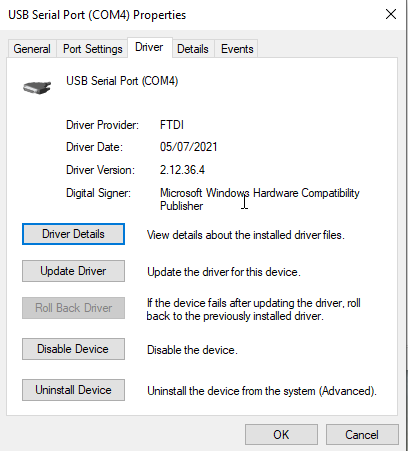
I fired up a Windows virtual machine and connected the board. The FTDI driver was automatically installed and I could access to board on a COM port. Perhaps one thing of interest is the comment in the 'information' part of the last screenshot, but otherwise I got the same VID/PID and driver date and version:
Why its saying that it "requires further installation" I am not sure.
Its obviously not an FTDI chip as both the FT232R and FT232RL have a different form factor and I could not find any reference to one being made in the form factor of those on the clone Nano boards, which, incidentally do look like a CH340G. In fact, I did wonder whether it would be possible to replace it with a CH340G? However, this also raises the question of WHY bother going to the trouble of faking the VID/PID on some mystery IC and erasing the markings when they could have used a CH340G anyway? Would it have something to do with being able to get it to work with a USB-C connector perhaps?
In any case, when you have weird shenanigans like this going on, the result is bound to be unpredictable.
Just to add that I found a Nano board with the CH340G and a bit of probing shows this is not a CH340G with modified PID/VID. Power pins were at the opposite end of the chip, but its not just a flipped die either, because the Tx/Rx pins are placed different differently, so not a drop in replacement for the CH340G either. Re-packaged cloned FT232RL chip perhaps but with fewer exposed pins?
Would it be a safer bet to look out for Nano's with the CH340G chip? But then, I'm not sure these have the 328PB variant onboard.
I have received one today and I can confirm that it uploads the sketch on these boards without issues, which is good news.
There is the disadvantage that in order to use the serial monitor, you have to disconnect the board and reconnect it via USB. Also the bootloader is overwritten. HOWEVER, if one uses a nano board that does not have this problem, they can use that until happy with the final sketch and then upload the final sketch on these cheap boards via USBASP or using the off/on trick. The little advantage is that you gain a little bit of extra space by overwriting the bootloader (not a lot but if you run out of memory and if you are happy with your final sketch...) and you can always update the sketch via USBASP again...
PS: is there any nano board that anyone has bought for relatively cheap on AliExpress that works without this hassles? if you have bought one please post the link
Thank you for sharing this information. I am quite interested in understanding more about these mysterious chips so this
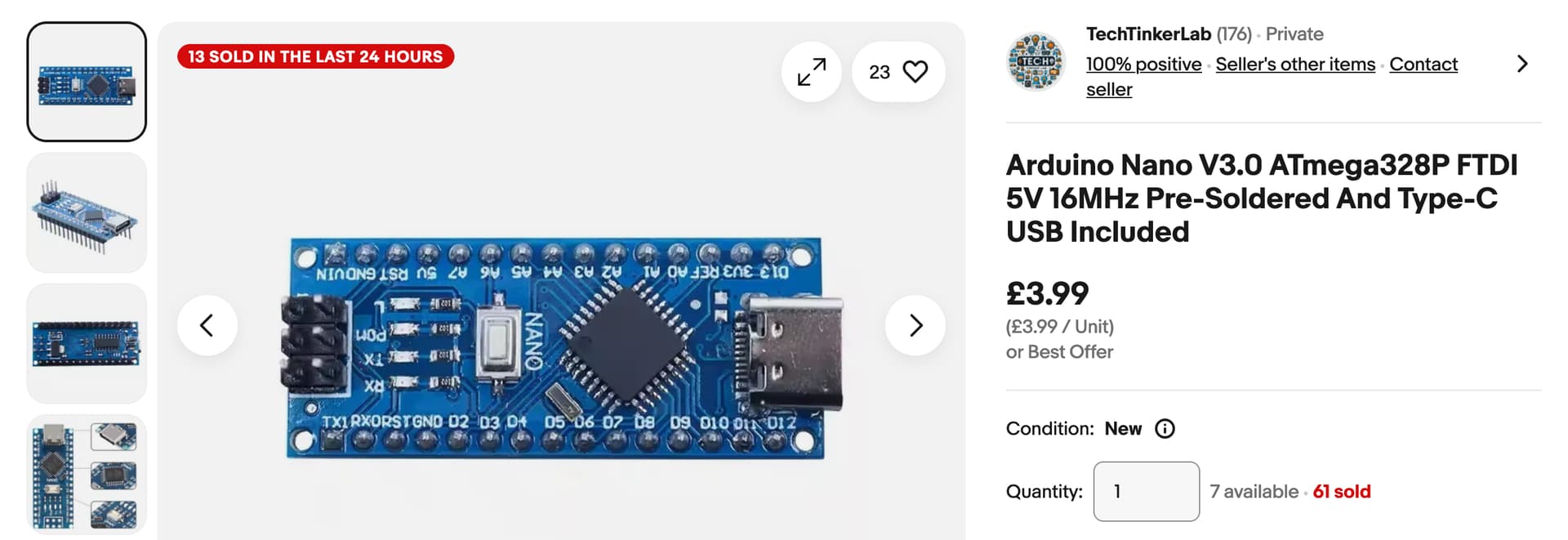
I would definitely stay away from any listings where the product photo shows a SOIC-16 chip and the description mentions FT232.
However, the product you receive doesn't always match the hardware shown in the product photo. Ironically, I have actually suffered from this in a reverse role: I have been hampered in my ability to support the affected users due to not owning one of the boards with the problematic chips. So I went on a shopping spree on Amazon, buying every cheap board and USB to serial bridge module I could find where the product photo showed a blank SOIC-16 USB chip. I was very disappointed to find that every one of the products I received had a labeled and perfectly functional CH340 chip.
Thanks. I am fortunate perhaps that the board I received seems to work OK on Linux, which is where I do most of my project work. However, given the reported problems on Windows, your advice is duly noted.
Unfortunately just so! What you actually get can sometimes be a bit pot luck!
I have just made a purchase for similar reasons and selected one of each of 3 types of board being sold by a particular seller on Ali with the intention of familiarising with the various flavours and testing for my project:
Micro-USB with CH340G
Mini-USB with unknown etched chip
USB-C with CH340G (as opposed to 'FT232' which I already have)
I am hoping that I will actually receive one of each and of exactly the product shown in the photos, but we will see....
Other annoyances include vendors having the wrong photo or the selection flipping back to the first or some random item in the list through some unintended browsing action (such as pop-up getting in the way) without being noticed. I recently purchased what I though was a particular Nano variant and ended up with a UNO style breakout board for a Nano... The of photo of the product shown was of 3 side-by-side Nano boards. Such are the trials and tribulations of ordering from China!
FWIW, I suspect most of the problems posted recently in this vein relate to items purchased directly from AliExpress, or originating there. Certainly, mine have been, as only my first 3 Nano clones (of 30+ now, 6 or 7 purchases) were from Amazon.
Ali is even less likely to use a photo that resembles the product, the multi-option product listings can be deceptive, and product descriptions are guaranteed to be meaningless, but so far every Nano I have bought has been made to work, somehow, including the '328PB ones I fought with in April. Of course, most of the links to items previously purchased no longer work, an added frustration.
So, if you really want a headache, a buying spree at AliEx might be "fun".
I agree that I would likely have achieved my objective if I had chosen AliExpress instead of Amazon. Amazon has significantly higher seller fees and draconian policies, which likely makes it not economically viable to use as a platform for selling products that are likely to result in a lot of customer complaints.
Unfortunately it is currently quite inconvenient for me to receive packages in the manner that is generally produced by shopping on AliExpress or eBay (individual packages without tracking randomly trickling into my PO Box over the course of months). So I have switched to using Amazon instead as it allows me to get the orders delivered to my home address, and in somewhat consolidated shipments.
Having no other 5V board to hand for a quick test, I used the Nano with the "FT232R" chip that has its markings erased. I ran into the same kind of issues on Linux that the OP ran into on Windows. I could upload once only and on subsequent uploads it would fail with an error saying the at the serial port was no longer available. Unplugging the board cleared the fault and allowed me to upload normally again.
I guess I spoke to soon regarding it being OK to use on Linux, so I thought I would report back with an update. The experience just underscores the point made earlier by ptillisch that far east Nano boards with a mention of "FT232R" are unreliable and best avoided, regardless of what operating system one might me working on.
Nano with328PB, USB-C, unknown UART, not recognized by OS
The board with the USB-C connector is identical to the one I already have, except that the one I already have actually works, although with the problem described by the OP.
I guess "two out of three aint bad" and I can always program the faulty one via the SPI port.
The board with the 168PA should allow me to test some firmware that was originally designed to run on that MCU, so having it is actually useful in this instance, but its not what I ordered or expected.
The experience does go to show what was said earlier, that one should expect the unexpected when ordering from AliExpress!
Have we figured out the actual problem with these?
For instance, if it was incompatibility with the DTR-based RESET, it might be useful to install a bootloader with an increased timeout and do manual RESETing, like in the old days...
The only information I have about these chips is what was shared here and in the other posts I linked in post #17:
and #19:
I don't think there is anything of interest in the other topics though. I think the most relevant information is the workaround @fluxia shared:
We have been seeing these chips appear in the community for some months now so I guess there are quite a few of the boards on the market. Since the obvious symptom is not very distinctive, I would guess that there have been a significant number of other unsolved reports of failed uploads caused by these chips, but just not identified as such.
So it would be great if a more convenient workaround could be found to help out the unfortunate community members who end up with bad boards.
Sorry, yes, should have been more explicit about the description. It is the SOIC-16 package without any markings on top.
Just to be sure, I tried a different USB-C cable on the one that didn't identity itself and it also came up as an "FTDI" as well. No surprised there, but, out of the 3 boards, I have one CH340G and two of the supposedly FTDI.
Out of curiosity I did a pinout comparison with the Holtek HT42B534 chip that appeared on the Logic Green version of the Nano and came in the same SOIC-16 package, but it doesn't match that either.
One thing I did find is that there are 3 direct connections direct to the 5V rail so I don't know for sure which one is actually VCC. It would seem that a pin or two pins might be being pulled high by direct connection to VCC rather than via pull-up resistors.
The connections to the chip appear to look like this:
With the exception of minor layout differences due to the different USB connectors, the two boards with the "FTDI" chip appear to have identical connections.
You have to wonder if buying these cheap devices is really worth all the effort of getting them working.
One brand that seems to be trouble-free is Elegoo.
By all means experiment later on, but if I were starting out again, pay a bit more and get the genuine items, complete, hopefully, with good quality, genuine components.