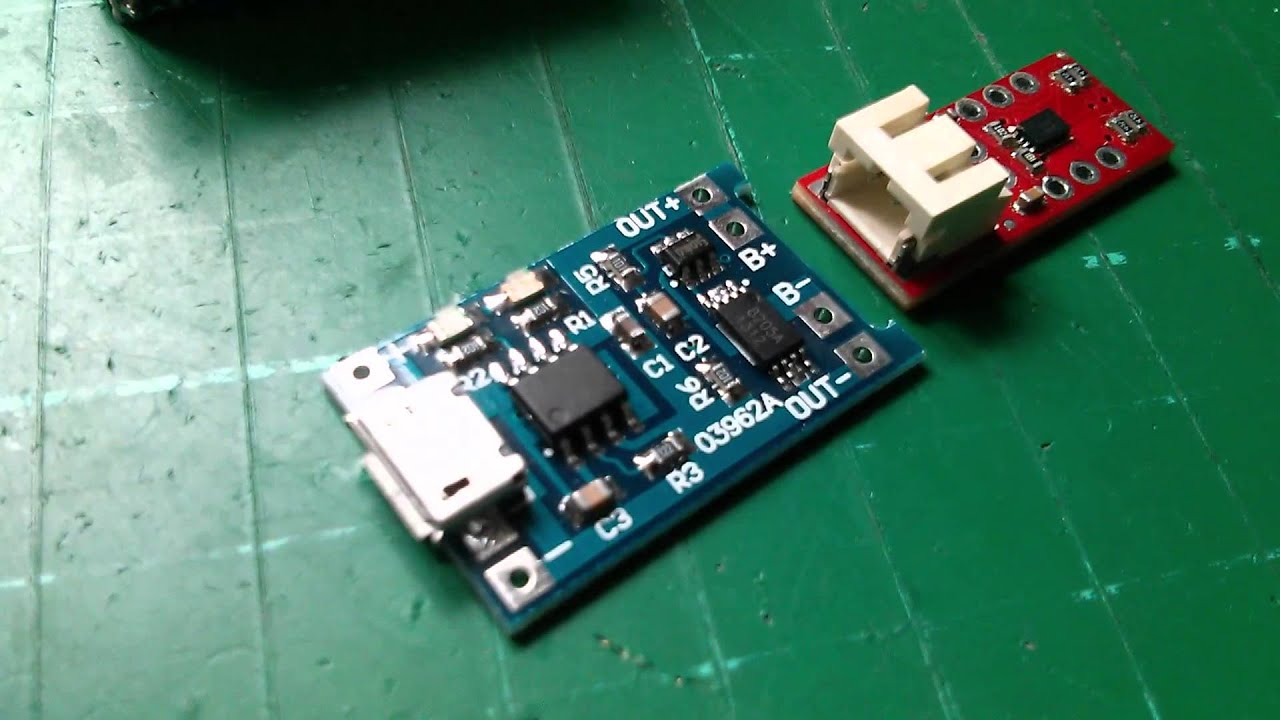
Hello all, I am exploring for the first time using a battery in my project, but i want to be really sure that what I am doing make sense.
Initially I bought a XIAO ESP32c3 as i knew it had the battery management included, but later i discovered that my 18650 cell i bought is unprotected, so i wanted to make the system more secure and I got suggested to use a TP4056.
The system also has a MAX17043 to get information about the charge level of the battery.
Is this wiring correct?
The XIAO ESP32c3 has no battery management capabilities.
The TP4056 is a LiPo battery charger IC, but offers no protection from battery overcurrent or overdischarge. Use a battery with a protection PCB built in.
As mentioned above, the XIAO has a protection chip, so your battery does not need one.
Suggested by.... ChatGPT?
TP4056 protects during charging, not discharging. Some TP4056 modules also include discharge protection chip/circuit, but not all do. But you don't need either type.
I wonder what the phrase "Supports lithium battery charge and discharge management" actually means, and given the following cautionary statement, assumed that the capability is theoretical.
Sorry, we currently have no way to help you check the remaining battery level through software (because there are no more chip pins available), you need to charge the battery regularly or use a multimeter to check the battery level.
Seems nearly useless without that elementary function.
On the schematic of the ESP32C3 the battery pad is connected, via a MOSFET, to the input of the devices 3v3 regulator. The MOSFET appears to be off when USB power is connected.
I cannot see any mechanism for a low voltage cutoff, maybe others have ?
The document states that the battery charge chip is ETA4054S2F. That this is a charging chip and doesn't mention any feature to protect against over-discharge...
The XIAO ESP32-3 does have a charging circuit, but does not have a battery protection chip.
I protected my 18650 cell with a 3Amp strip as shown in post#4.
They come in a snap-apart set of three or more.
It has the same under/over voltage/current protection parts as you can find on a protected TP4056 board.
Leo..
Look at the smallest version in your post.
The small chip is the detection chip, the larger one is the mosfet cutoff switch.
The higher current versions just have more mosfets fitted.
Leo..
I did not see any battery protection in the circuit diagram.
And they picture a battery with built-in protection on their product page.
Don't stress out too much. I used my board without protection for several weeks before the protection strip arrived. If you are using an 18650 battery holder, then it's easy to solder a 3A protection strip to the bottom.
Leo..
@francescofact it's beginning to look a lot like... Seeed Studio's documentation may not be accurate about this, and you may need to add protection for your unprotected 18650.