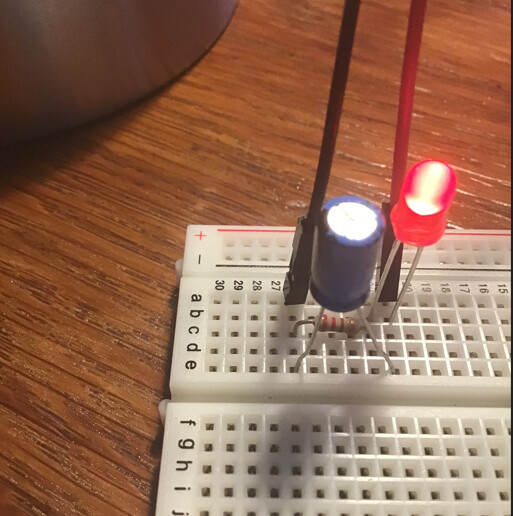
But Why?
Lighting a LED for two seconds can be done in software much easier.
Leo..
But Why?
Lighting a LED for two seconds can be done in software much easier.
Leo..
I know. But I'm not an EE and I'm trying to learn behaviors of various electronic components, hence my very simple setup as per post # 59.
Have you tried the circuit that I had suggested earlier, in Comment #27, or was there a reason you are reluctant to use this solution?
You did limit LED current with a resistor. Just add a second resistor in the 5volt line to limit inrush current of the cap, so you can use any larger cap value safely.
Leo..
That resistor would go where exactly?? Is that resistor to protect the Arduino??
pos#27.
A resistor can go in series with the cap, or inline with the 5volt lead (better).
Leo..
Placing the resistor inline with the 5V lead would reduce the LED brightness, and reduce the duration of the fading process.
Op, please answer questions put to you.
A Schottky Diode in series with the LED cct. would be warranted.
My best guess is that OP means simply yanking the red wire out of the female header connector for the 5V pin.
Two resistors in series with the LED also reduces brightness.
A diode could eliminate discharge back into the Uno.
Maybe all this "learning" is better done in a simmulator, likr LTspice.
Leo..
Not if I remove (yank) the red wire from the breadboard, am I right??

That's right, yanking the red wire
Good idea the diode
Great, thanks
If you value your Arduino, then don't use it as a power supply for experimenting. You are obviously new to electronics and the chances that you damage the Arduino are very likely.
Buy a 5V power supply for your experiments and use the Arduino as it was intended to be used.
It would be around 8A. 3/(2*0.186)
If you're saying that the ESR is not frequency-dependent, then how do you explain that the capacitor's impedance at 100 kHz is given in the datasheet as only 15 mΩ, an order of magnitude lower than the ESR?
Surely, |ZTOT| = ESR/sin(δ), so if the ESR is not frequency-dependent, then the total impedance can never be smaller than the ESR!?