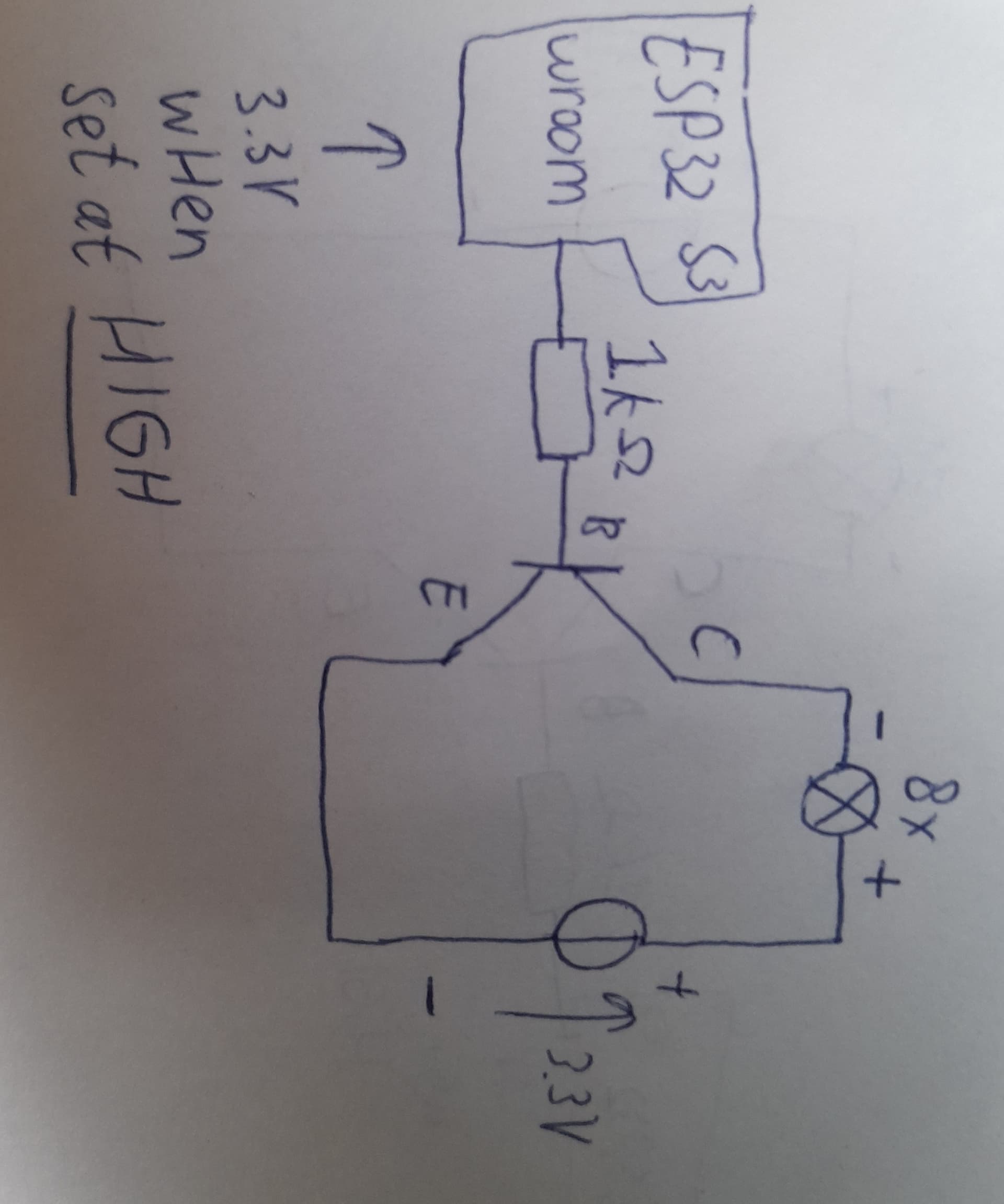
I know the transistor i am using may be a bit overkill but i just had it lying around and dont bother using it.
As led Power source i am using the 3.3V output from one of my ZK-5AD 2-DC motor drivers.
And everything is power from the same 3S li-ion 18650 battery pack.
Your schematic does not show a ground connection from the ESP. You really do not know enough to make circuits and should take many lessons before trying to wire anything.
See that arrow on the emitter? It indictes the direction of the conventional current flow. You will see that for a PNP transistor this will be in the opposite direction to an NPN one. You will need to arrange your circuit accordiingly. Also you should note that the voltage at the base needs to be at least 0.7V lower at the emitter, rather then higher, for the transistor to turn on. You may need a pull-up at the base to keep it turned off. You should probably also use a current limiting resistor in series with your LED(s), assuming that is a LED and not an incandescent bulb.
Complement is something that makes complete, or in this case you could say opposite equivalent, so a transistor with the same general characteristics but with the opposite polarity.
Basically your circuit needs to be re-designed (and corrected) to take into account the opposite polarity of the transistor you are trying to use or else find NPN transistor.
Thank you.
Does 8X parallel mean that you have 8 LEDs wired in parallel?
You would need to use an NPN transistor to switch the ground side as you have drawn. Also you have switched the labels of the emitter and the collector.
Google transistor switching circuits and redraw your circuit. Also google how to use current limit resistors with LEDs and how to safely use LEDs in parallel.