Looking good so far

- Have you considered using a 5v buck converter ?
For what?
- I was assuming the two chips above the power plug were low dropout regulators.
If so, the 5v regulator could be a SMPS circuit allowing more output current for peripherals.
I might implement that on V2, V1 has a priority on making sure it works
-
Let’s see the traces on the bottom of the PCB.
-
Suggest you avoid GND pour on the component side.


-
GND pour on the top of the PCB is not warranted.
-
You have very long traces that are cutting the bottom GND plane.
You should: avoid these, add strapping on the top, or zero ohm resistors across them on the foil side.
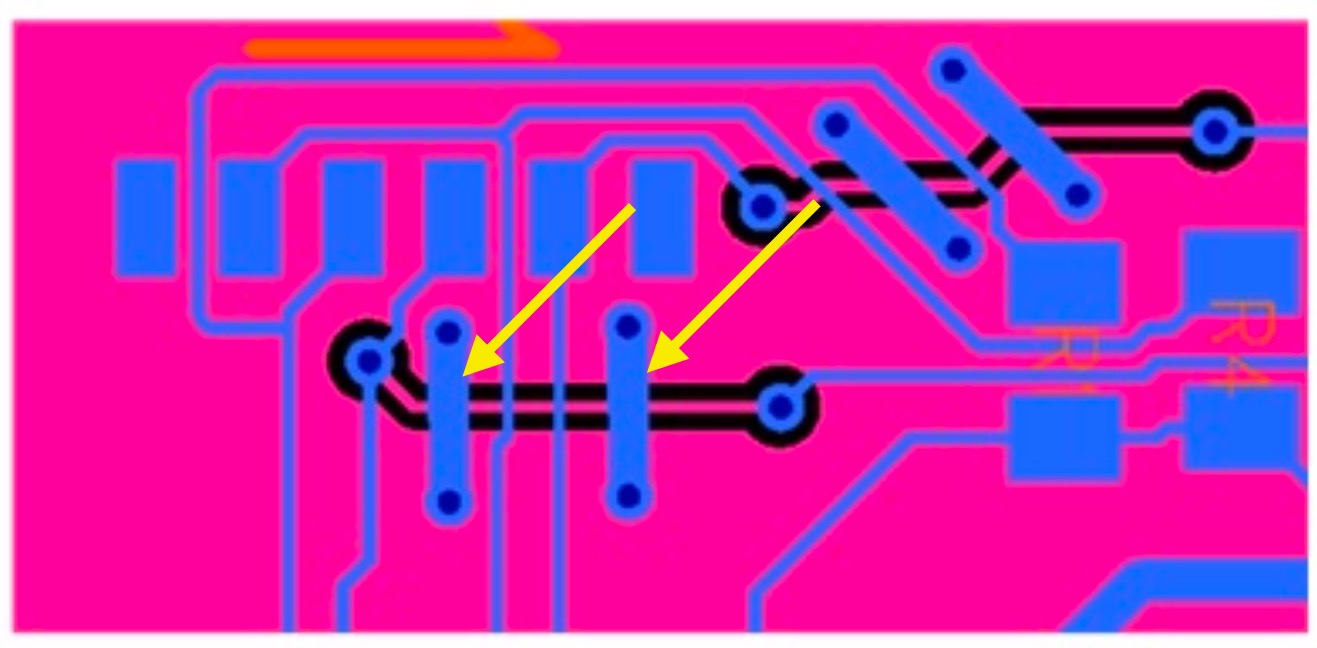
The bottom pour is not a gnd plane
Even the official Uno has a pour on both top and bottom, and no straps. Why is that?
The bottom pour is not a gnd plane
It should be a GND copper pour.
Provides the signal return paths for the top traces.
Even the official Uno has a pour on both top and bottom, and no straps.
Poor design on their part.
Why is that?
Straps over bottom traces correct contorted signal return paths.
- Watch this YouTube video, pay attention to time around 40 minutes.

1 Like
What if the top is the GND pour?
- The above video goes into that.
- Also, watch this:

Hi, @outbackhut
Engineers solution;

It would be great for R&D.
If the first configuration didn't work with one controller topography, just twiddle a few knobs and change the conditions.
Non-Volatile Memory.
Tactile adjustment system.
With proper handling 1V8 to 180V operation.
Tom.... 


1 Like
Dare I ask what solution this is solving? 
-
Design low noise PCBs by adding a ground plane on the bottom side.
This ground plane should be unbroken by bottom traces.
If traces must be on the bottom, keep them as short as possible and add a top side strapping so return signal currents are not interrupted. -
Now you are an expert.
Here is one last video you should watch.

1 Like
- Thought you were told to get into the medical line of business.

1 Like
What's the dig deal, looks like another Uno but with an SD card slot
This board is:
-
Modern AVR core
-
Hardware secure element (keys that cannot be extracted)
-
Temperature-compensated RTC with ppm-level accuracy
-
High-resolution power monitor for real energy profiling
-
Separate internal and external I²C domains
-
Dedicated SD SPI bus (not shared with shields)
-
Cryptographic identity + signing capability
-
Designed around low-power operation and measurement
Can it run from a single Li-ion battery?
V1.0 doesn’t have a lithium charger on board, but V2.0 will.
Irregardless, yes, it will run off a decent sized battery (2000 mAh or more) for a decent amount of time. Exact time will be calculated once the board has progressed past R&D