hi guys
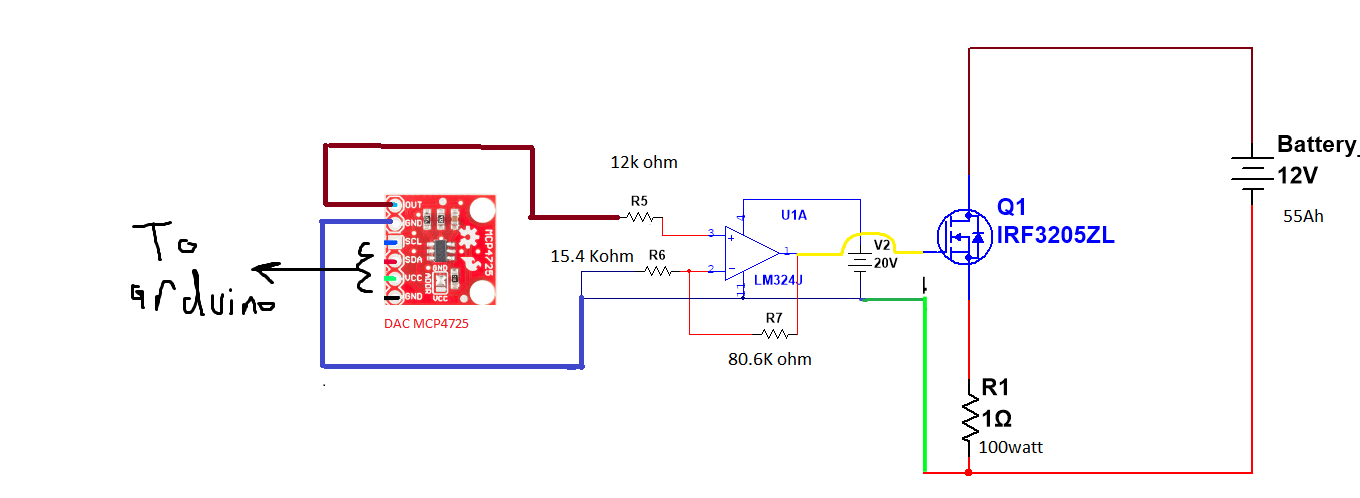
In this circuit I'm trying to drain a battery with a mosfet and resistor.
According to the voltage drop on the gate of the mosfet the current value will changable and it may pass 10Amper.
my question is this circuit okay and can run safely or it may damage the componnets (arduino ,mcp, op_amp), and should I separate it from control circuit , and how this could be done?
Wrong circuit.
Feedback for the opamp should come from the voltage across R1.
Note that a TO-220 package, mounted on a large heatsink, can't dissipate much more than 20watt.
That limits your circuit to 2Amp.
Max power dissipated in the fet is with 6volt across the 1ohm resistor.
6volt * 6Amp = 36 watt.
Leo..
I use mains based light bulbs. For my usage the current is almost constant. A few volts over a 120V lamp, the lamp temperature does not change much hence neither does the current. That load could be shunted with a controllable load, for which I use a BJT, rated at many amps.
Current of that circuit depends on Vgs(th) of the fet, which is unpredictable.
There must be a direct feedback if you want to set an exact current.
I suggest powering the opamp from the 12volt battery, R1 reduced to 0.47ohm (assuming 5volt-logic Arduino), another 0.47ohm between battery(+) and drain, and a resistor the same value as R5 between fet source and opamp -input (no R6, R7).
Leo..
according to the datasheet it can dissipate 200watt.
for the feedback I didn't follow you my friend can you explain a little more how the circuit will be a piece of paper or just a line on picture would be great.
for the set current , in code I will make a while loop if the current is smaller than the set current ,mcp will increase the voltage by 0.1 and the op_amp will multiped by 5 .
and if it's smaller the same idea it will decrease the voltage applied on the mosfet gate.
No I don't just to turn on and off i need to pass a value of current that the user deteime it and thats why i need to have a presion with the voltage applied to the mosfet gate.