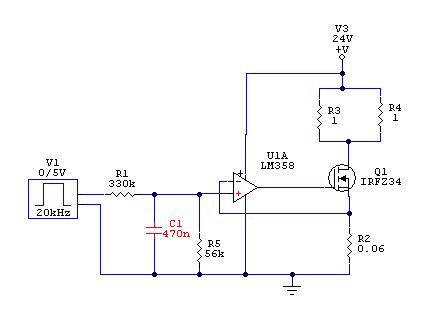
Hello Mr_F,
You wrote: "the device is going to be stuck in the saturation region unless the pwm is off for a while."
It seems you do not know what saturation is for a MOSFET, which is almost opposite what is defined for bipolar transistor saturation.
Saturation : when the Vds > (Vgs-Vt)
Linear : when Vds < (Vgs-Vt)
For Arduino PWM outputs from 0 to 5 volts and for Vt threshold of 2 volts, the MOSFET is saturated when the drain voltage is over 3 volts. When it is saturated, the current varies with the square of the gate voltage.
Ids is proportional to (Vgs-Vt)^2
Linear operation of a MOSFET occurs only for small drain voltages, like 1.0 volts. If you have 10 volts on the drain and 5 volts on the gate, it is saturated and the "square law" is used to calculate the current versus gate voltage. The drain current becomes a "constant current source" in saturation for constant gate voltage. The drain's constant current sourcing is probably not what you want, and I assume you want the drain current to have a "linear" increase of current when the drain voltage increases. To get linear operation of a MOSFET drain IV curve, use drain voltages that are very small compared to the gate voltage.
Alternatively, you could put the MOSFET in the linear region when the drain voltage is near 10 volts if you bias the gate voltage above 12 volts .
Linear:
Vds < (Vgs-Vt)
10 volts < (15 - 2)
where
Vgs is an amplified PWM at 15 volts
Vt is 2 volts
Vds is 10 volts
Mr_F wrote: "the MOSFET is probably staying on the whole time that the PID is trying to maintain a constant value."
Yes. It is common for a MOSFET to always be "on". Please tell us if you want a constant voltage or a constant current, not just a constant "value".
If the PID is fast and the gate filter is slow, that is acceptable to me, but what is you goal for acceptable performance? In this case, the slow gate voltage changes will cause a slow drain current change, but we do not know what your circuit does. With no gate filter, the PWM will slam the drain currents so fast your PID feedback will not be able to respond quickly enough, causing oscillating drain currents.
references : npn saturation : transistor saturation? - Page 1