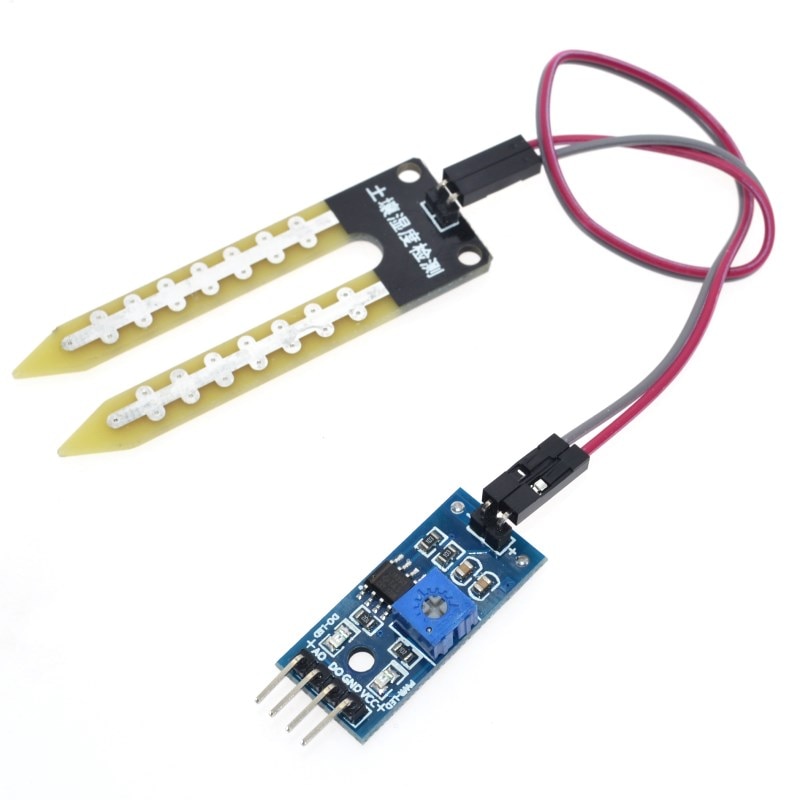
When I tested it with a breadboard just to get to know it, it got really really hot. It says it can handle 3.3-5V, so I didn't bother adding any resistance. The output on the PCM says +/-, but the sensor itself only has a Chinese word/sentence. I tried both ways and it seemed to send the same signal anyway.
Is it supposed to overheat like that, or is it something I have overlooked?
On a sidenote, it sent analog signals between 640 and 670. I didn't quite understand the scale since it didn't seem to make any big difference between a glass of water and a moist plant. Hints appreciated.
I'm not proficient enough to duplicate the PCB thing the hygrometer came with so I can't provide a useful diagram. Soz.
5V -> Ucc
GND -> GND
A0 -> analog inngang
Den analoge verdien du kan lese med analogRead() skal variere slik at du kan skille tørt fra fuktig
Potmeteret kan du bruke til å sette en passende verdi for å få 'alarm'på DO (digital out)
.........
Det skal IKKE bli varmt ! Hvis DET er tilfelle, så er noe defekt.
Please read the first post in any forum entitled how to use this forum. http://forum.arduino.cc/index.php/topic,148850.0.html then look down to item #7 about how to post your code.
It will be formatted in a scrolling window that makes it easier to read.
Can you please post a copy of your circuit, in CAD or a picture of a hand drawn circuit in jpg, png?
If you are having trouble drawing a circuit diagram can you post some pictures of your project do we can see your component layout please?
What model Arduino are you using?
This link may help you understand how to use your sensor.
As mentioned, I got the code and circuit right - I got analogue signals as expected.
It was the heating up of the sensor PCB that stumped me.
I'm not a noob programmer, just noob with the electronics.
I ordered two sensors, so I'll try the other one to see if it behaves differently.
Might be a reason "The item is no longer available" on aliexpress...
I'll post again and try fritzing up a diagram if I still have problems.
Thanks again,
Lars-Erik
(If you're curious, here's the code I ran. I also hooked up an LCD with 4 bit output to read the value)
#include <LiquidCrystal.h>

const int rs = 9, en = 8, d4 = 7, d5 = 6, d6 = 5, d7 = 4;
LiquidCrystal lcd(rs, en, d4, d5, d6, d7);

void setup() {
  // put your setup code here, to run once:
  pinMode(A0, INPUT);

  lcd.begin(16, 2);
}

void loop() {
  // put your main code here, to run repeatedly:
  float val = analogRead(A0);
  String input = String(val);
  lcd.setCursor(0, 0);
  lcd.print(input);
}