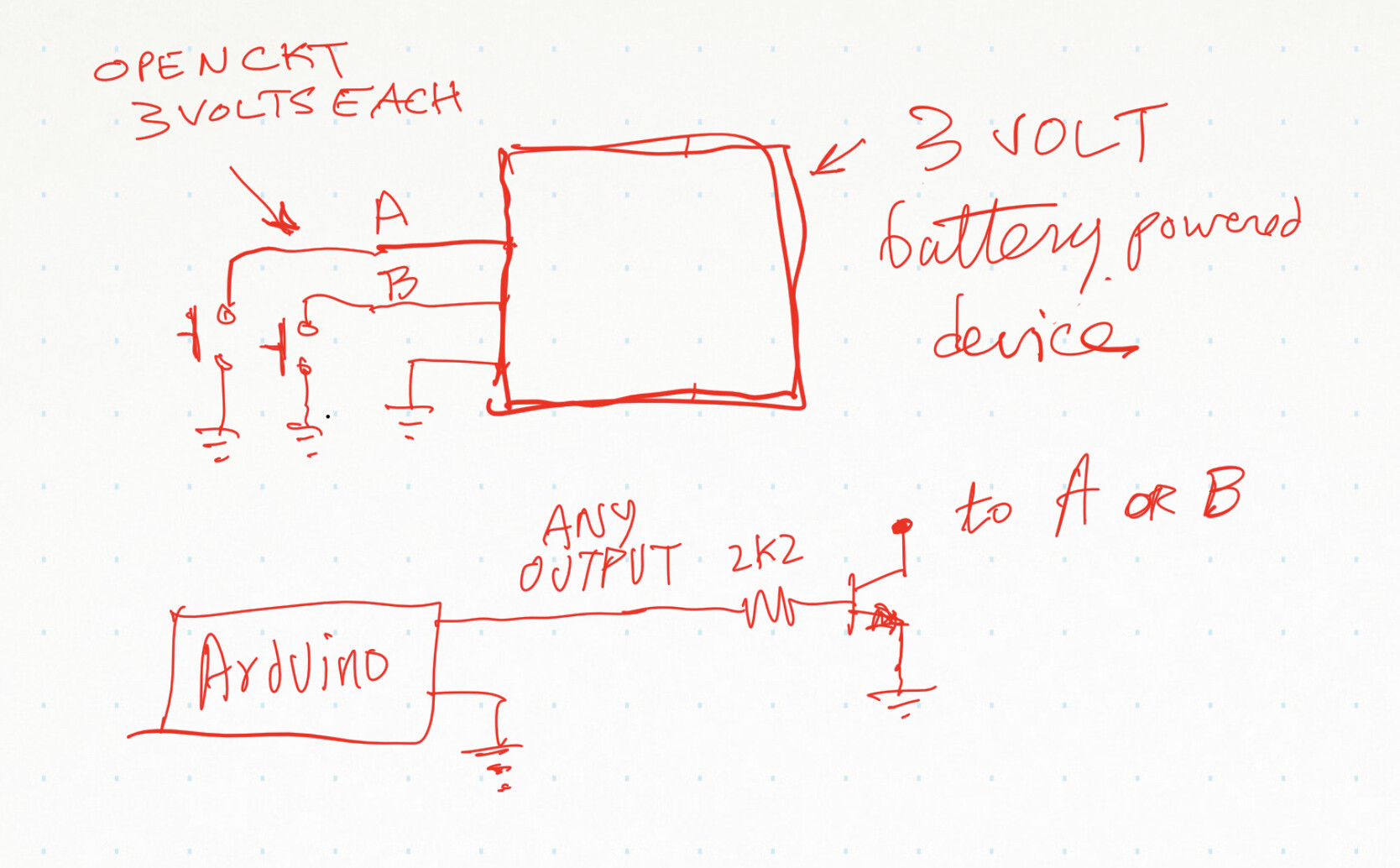
Can I safely use my meter to measure the current induced by a switch that pulls down a mystery input on a device being hacked?
The input has 3 volts on it, Vcc in this a battery operated device. The switch is not switching power - there are two of these inputs, one for each of two functions that would normally be invoked with mechanical shorting.
I do this fearlessly. On the other hand, I live with consequential damages of all kinds, usually but not always learning something from "accidents".
I'm about to suggest to a forum participant a measurement of that current just to be sure a transistor would not be instant destroyed if used instead of a mechanical switch.
I really don't think she's destroying optoisolators, but if we find that there are two busted optos, seems like a thing to think about so…
I'm 99.44 percent sure there is almost no current, or certainly not so much as to destroy a transistor, but I am reluctant to be here while over there some (any) bad thing happens.
Probably OK, but you know what we need? One of those scratchy schematic thingies, you know, take a pointy drawing stick thing and some papyrus and draw a diagrammy thing. You know how this works.
Seriously, I can't tell from your description, I can't imagine a schematic would be that complicated or difficult. Or maybe someone else understands from your description.
I hope this clarifies. Looking to replace a pushbutton with a transistor turned on by a digital output, so I'd like to know how much current flows through the push buttons when they are closed.
If you have a multimeter you can put it in current mode and put the probes across the switch contacts. (In current mode, the meter is effectively a short circuit and current will flow.)
If there is a motor or anything inductive in the mystery device you can get a momentary high voltage "inductive kickback" when the voltage is switched off. That voltage is reversed so a "backwards" diode across the transistor will protect it.
Opto-isolators are usually rated for less than 100mA so you might fry an opto-isolator whereas most transistors would survive.
You also need to check the transition voltage (when the electronics switch) and be sure your transistor can pull it down to that point. If you are not sure you can use a MOSFET.
Thank you gentle people for the validation. As I said, I have done this more than once, I just hate to tell someone
All ground symbols in my papyrus and stylus depiction are connected.
If that is in fact also the negative battery terminal is not known, the only reason I have to not doubt that that is the case is the three volts measure at the switch high side. 3 volt nominal, device has two AA batteries so.
The ground I show on the device is the sleeve connection of a TRS jack on the device. The existing "controller" is electrically just two switches.
Since there are no other connections, I think it might not matter if somehow that turned out to not be the battery negative side.
Possibly not relevant in this context but please do not confuse battery or PSU negative with ground. Often they are treated as synonymous, but they are different things. Ground is a point designated by the circuit designer, generally also 0V, and the point at which other voltages are measured unless stated otherwise. Often, but by no means always, 0V / ground is also the negative supply point. Some circuits have the positive supply as 0V, some have a split supply with 0V somewhere (not necessarily half way) between the most negative and the most positive voltage.