I have two commercially available finger cuffs, one from Masimo and the other from Nellcor. The sensors have an integrated IR and Red LED and also a photodiode (Nellcor) and phototransistor (Masimo). The finger cuffs are for reading pulse and determining oxygen saturation. I put the red LED in series with a resistor to turn it on and I put the photodiodes in reverse bias and in series with a resistor (a simple current to voltage converter). When I read the voltage at the output of the current to voltage converter, The signal does not appear to be stable. When I put a piece of paper to block the LED from reaching the photodiode, the signal appears to oscillate sinusoidally when it should be flat.
I am guessing the photodiode/phototransistor are extremely sensitive, but there is not enough stray light to influence the readings. As you can see in the picture, they are situated to eliminate stray light (the Nellcor cuff more so than the Masimo cuff). But I positions both of them appropriately so that ambient light would not affect the measurements.
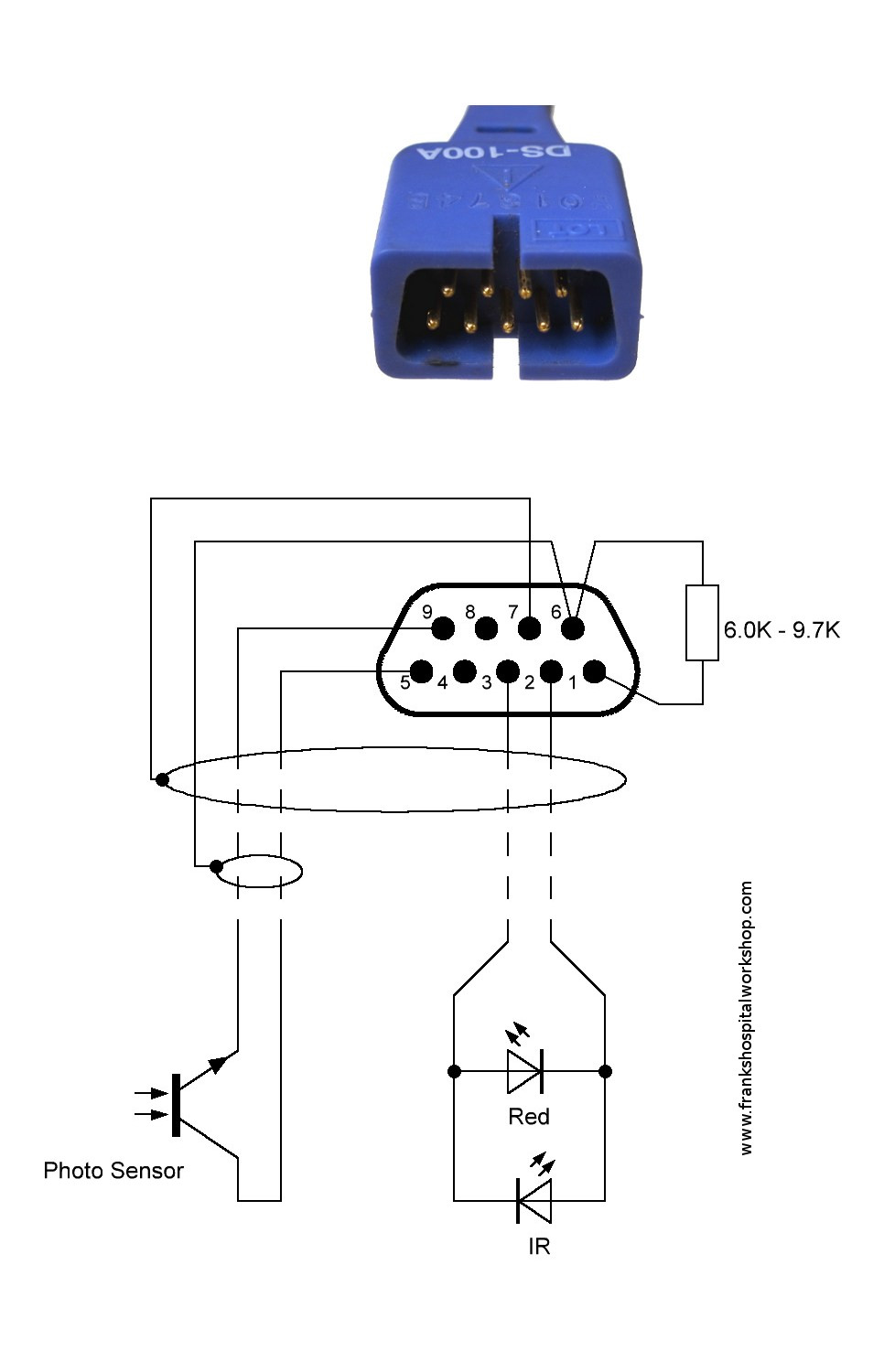
Anyone have any experience with these guys? The sensors have a DB-9 (Nellcore) and a DB-7** (Masimo, it is the same configuration as a DB-9 connector, but pins 4 and 8 are missing). The exact pin outs are proprietary, but you can find some info online.
Any help would be appreciated. Thank you.

