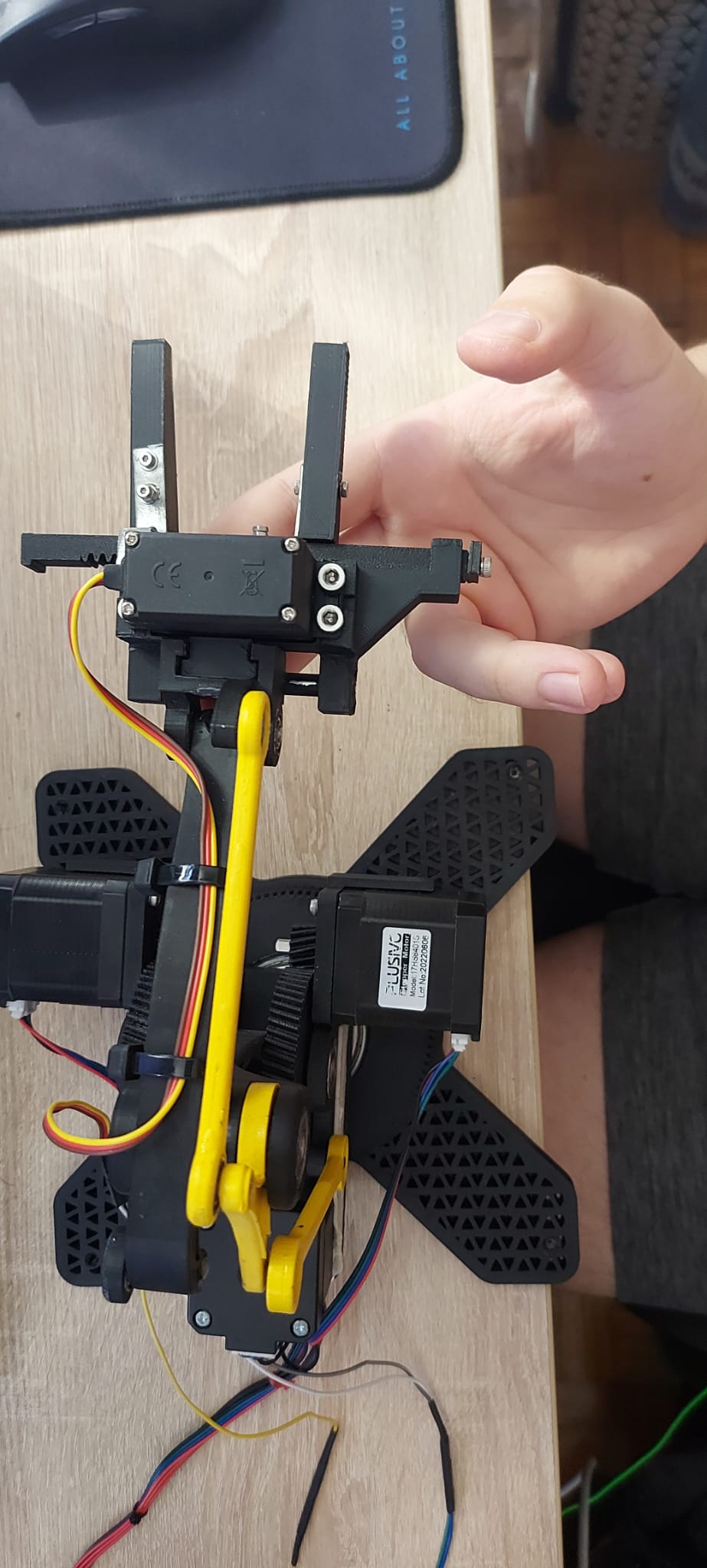
Recently I built a 4-axis robot for palletization applications with its 4th axis being mechanically controlled, the rest of the 3 axis are controlled by nema17 motors using a drv8825 driver, a cnc shield v3 and a arduino mega, the problem I am encountering is that despite de correct calculations of the inverse kinematics, I am struggling with the precision of its movements, mainly translating on its y-axis and z-axis, I attached below some images, videos and the code

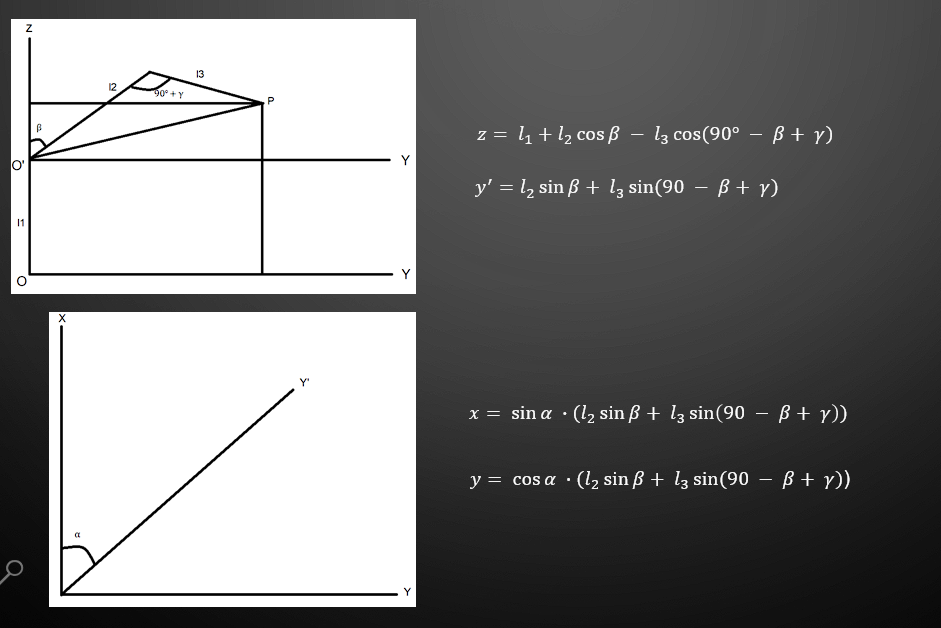
Forward Kinematics

Inverse Kinematics
#include <MobaTools.h>
#include <math.h>
#include <FastTrig.h>
#include <string.h>

#define pin 38
#define step1 2
#define step2 3
#define step3 4
#define dir1 5
#define dir2 6
#define dir3 7
#define l1 69.5
#define l2 100
#define l3 100

MoToStepper motor1(800, STEPDIR);
MoToStepper motor2(800, STEPDIR);
MoToStepper motor3(800, STEPDIR);
MoToServo servo1;

int step = 0, pos1 = 0, pos2 = 0, pos3 = 0, servo_pos = 0;
double xp, yp, zp, alpha1, beta1, gamma1;
bool Joint_Mode = true, First_Message = true, Repeat = false, Play = false;

double degreesToRadians(double degrees) {
  return degrees * M_PI / 180.0;
}
double radiansToDegrees(double radians) {
  return radians * 180.0 / M_PI;
}

void setup() {
  Serial.begin(9600);
  delay(1000);

  servo1.attach(pin);
  motor1.attach(step1, dir1);
  motor2.attach(step2, dir2);
  motor3.attach(step3, dir3);
  motor1.setMaxSpeed(200);
  motor2.setMaxSpeed(200);
  motor3.setMaxSpeed(200);
  motor1.setRampLen(10);
  motor2.setRampLen(10);
  motor3.setRampLen(10);

  Serial.println("Set the Step size using - and + keys.");
  Serial.println("Joint mode can be toggled on and off with the q ans w keys.");
  Serial.println("Effector is controlled using i, o and p keys");
  Serial.println("The robot is controlled with the numpad using all the numbers");

  alpha1 = motor1.currentPosition() * 0.1125;
  beta1 = motor2.currentPosition() * 0.1125;
  gamma1 = motor3.currentPosition() * 0.1125;

  xp = (l1 * sin(degreesToRadians(beta1)) + l3 * sin(degreesToRadians(90 - beta1 + gamma1))) * sin(degreesToRadians(alpha1));
  yp = (l1 * sin(degreesToRadians(beta1)) + l3 * sin(degreesToRadians(90 - beta1 + gamma1))) * cos(degreesToRadians(alpha1));
  zp = l1 + l2 * cos(degreesToRadians(beta1)) - l3 * cos(degreesToRadians(90 - beta1 + gamma1));

  zp = zp - l1;
}

void loop() {
  double alpha, beta, gamma;

  if (Serial.available() > 0) {

    char input = Serial.read();

      switch (input) {
      case '+':
        if (step >= 100) {
          Serial.println("Step can't be set higher than 100!");
          break;
        }
        Serial.print("Step set to: ");
        if (step < 5)
          ++step;
        else if (step == 5)
          step += 5;
        else
          step += 10;
        Serial.print(step);
        Serial.print('\n');
        break;
      case '-':
        if (step <= 0) {
          Serial.println("Step can't be set as a negative value!");
          break;
        }
        Serial.print("Step set to: ");
        if (step <= 5)
          --step;
        else if (step == 10)
          step -= 5;
        else
          step -= 10;
        Serial.print(step);
        Serial.print('\n');
        break;
      case '7':
        pos1 += step;
        xp += step;
        break;
      case '8':
        pos1 = 0;
        xp = 0;
        break;
      case '9':
        pos1 -= step;
        xp -= step;
        break;
      case '4':
        pos2 += step;
        yp += step;
        break;
      case '5':
        pos2 = 0;
        yp = 100;
        break;
      case '6':
        pos2 -= step;
        yp -= step;
        break;
      case '1':
        pos3 += step;
        zp += step;
        break;
      case '2':
        pos3 = 0;
        zp = 100;
        break;
      case '3':
        pos3 -= step;
        zp -= step;
        break;
      case '0':
        pos1 = 0;
        xp = 0;
        pos2 = 0;
        yp = 100;
        pos3 = 0;
        zp = 100;
        break;
      case 'i':
        if (servo_pos == 180) {
          Serial.println("Servo cant go above 180");
          break;
        }
        servo_pos += 10;
        break;
      case 'o':
        servo_pos = 0;
        break;
      case 'p':
        if (servo_pos == 0) {
          Serial.println("Servo cant go below 0");
          break;
        }
        servo_pos -= 10;
        break;
      case 'q':
        Joint_Mode = true;
        Serial.println("Joint mode on");
        break;
      case 'w':
        Joint_Mode = false;
        Serial.println("Joint mode off");
        break;
      }

    if (Joint_Mode == false) {

      alpha = xp;
      double l = sqrt((xp * xp) + (yp * yp));
      double a = sqrt((zp * zp) + (l * l));
      beta = degreesToRadians(90) - acos(((l2 * l2) + (a * a) - (l3 * l3)) / (2.0 * l2 * a)) - atan(zp / l);
      gamma = acos(((l2 * l2) + (l3 * l3) - (a * a)) / (2.0 * l2 * l3)) - degreesToRadians(90);

      //alpha = radiansToDegrees(alpha);
      gamma = radiansToDegrees(gamma);
      beta = radiansToDegrees(beta);

      motor1.moveTo(alpha / 0.1125);
      motor2.moveTo(beta / 0.1125);
      motor3.moveTo(gamma / 0.1125);

      Serial.print("alpha = ");
      Serial.println(alpha , 10);
      Serial.print("beta = ");
      Serial.println(beta , 10);
      Serial.print("gamma = ");
      Serial.println(gamma , 10);
      Serial.println();


    } else {

      motor1.moveTo(pos1 * 16);
      motor2.moveTo(pos2 * 16);
      motor3.moveTo(pos3 * 16);
    }

    servo1.write(servo_pos);
  }
}
I modified some bits of the code, taking into account the x and y axis not the z and y, but the problem still persists, the robot translates at a 45 degree angle on the z axis, I tried all the combinations with adding, substracting 45 and 90 degree angles, I dont know what to do, any suggestions?