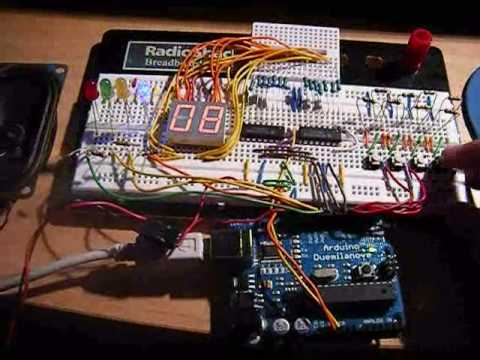
Sorry, totally forgot to post the code. As requested:
/*Simon Says game by Robert Spann*/
#include <EEPROM.h>

//Pin connected to ST_CP of 74HC595
int latchPin = 7;
//Pin connected to SH_CP of 74HC595
int clockPin = 8;
////Pin connected to DS of 74HC595
int dataPin = 6;

int switch1 = 5; //The four button input pins
int switch2 = 4;
int switch3 = 3;
int switch4 = 2;
int led1 = 9; //LED pins
int led2 = 10;
int led3 = 11;
int led4 = 12;
int turn = 0;
int speakerPin = 13;
int intro = -1;
int input1 = LOW;
int input2 = LOW;
int input3 = LOW;
int input4 = LOW;
int tenDisp;
int oneDisp;
int highTen;
int highOne;

byte dataOne; //Shift Register Stuff
byte dataTwo;
byte dataArrayOne[12];
byte dataArrayTwo[12];


int randomArray[100]; //Intentionally long to store up to 100 inputs (doubtful anyone will get this far)
int inputArray[100];


void setup() {

  Serial.begin(9600);

  pinMode(led1, OUTPUT);
  pinMode(led2, OUTPUT);
  pinMode(led3, OUTPUT);
  pinMode(led4, OUTPUT);
  pinMode(switch1, INPUT);
  pinMode(switch2, INPUT);
  pinMode(switch3, INPUT);
  pinMode(switch4, INPUT);
  pinMode(speakerPin, OUTPUT);
  randomSeed(analogRead(0)); //Added to generate "more randomness" with the randomArray for the output function
  pinMode(latchPin, OUTPUT); //Shift register output pin

  dataArrayOne[0] = B11111100; //7 segment number values for shift register 1
  dataArrayOne[1] = B01100000;
  dataArrayOne[2] = B11011010;
  dataArrayOne[3] = B11110010;
  dataArrayOne[4] = B01100110;
  dataArrayOne[5] = B10110110;
  dataArrayOne[6] = B10111110;
  dataArrayOne[7] = B11100000;
  dataArrayOne[8] = B11111110;
  dataArrayOne[9] = B11100110;
  dataArrayOne[10] = B01101110;
  dataArrayOne[11] = B11101110;

  dataArrayTwo[0] = B11111100; //7 segment number values for shift register 2
  dataArrayTwo[1] = B01100000;
  dataArrayTwo[2] = B11011010;
  dataArrayTwo[3] = B11110010;
  dataArrayTwo[4] = B01100110;
  dataArrayTwo[5] = B10110110;
  dataArrayTwo[6] = B10111110;
  dataArrayTwo[7] = B11100000;
  dataArrayTwo[8] = B11111110;
  dataArrayTwo[9] = B11100110;
  dataArrayTwo[10] = B01101110;
  dataArrayTwo[11] = B11101110;

  //EEPROM.write(1, 0);
  int value = EEPROM.read(1);
  highScore(value);
  warHymn();
  delay(1000);


  for (int y=0; y<=1000; y++){ //For statement to loop through the output and input functions

    output();
    input();
  }
}

void output() { //function for generating the array to be matched by the player

  scoreDisplay(turn);
  for (int y=turn; y <= turn; y++){ //Limited by the turn variable
    //Some serial output to follow along
    Serial.print("Turn: ");
    Serial.print(y + 1);
    Serial.println("");
    randomArray[y] = random(1, 5); //Assigning a random number (1-4) to the randomArray[y], y being the turn count
    for (int x=0; x <= turn; x++){

      Serial.print(randomArray[x]);

      if (randomArray[x] == 1) {  //if statements to display the stored values in the array
        digitalWrite(led1, HIGH);
        playTone(1915, 200); //Passes tone value and duration of the tone to the playTone function
        delay(200);
        digitalWrite(led1, LOW);
        delay(100);
      }

      if (randomArray[x] == 2) {
        digitalWrite(led2, HIGH);
        playTone(1519, 200);//Passes tone value and duration of the tone to the playTone function
        delay(200);
        digitalWrite(led2, LOW);
        delay(100);
      }

      if (randomArray[x] == 3) {
        digitalWrite(led3, HIGH);
        playTone(1275, 200);//Passes tone value and duration of the tone to the playTone function
        delay(200);
        digitalWrite(led3, LOW);
        delay(100);
      }

      if (randomArray[x] == 4) {
        digitalWrite(led4, HIGH);
        playTone(956, 200);//Passes tone value and duration of the tone to the playTone function
        delay(200);
        digitalWrite(led4, LOW);
        delay(100);
      }
    }
  }
}


void input() { //Function for allowing user input and checking input against the generated array

  for (int x=0; x <= turn;){ //Statement controlled by turn count
    input1 = digitalRead(switch1);
    input2 = digitalRead(switch2);
    input3 = digitalRead(switch3);
    input4 = digitalRead(switch4);

    if (input1 == HIGH){ //Checking for button push
      digitalWrite(led1, HIGH);
      playTone(1915, 200);//Passes tone value and duration of the tone to the playTone function
      delay(200);
      digitalWrite(led1, LOW);
      inputArray[x] = 1;
      delay(50);
      Serial.print(" ");
      Serial.print(1);
      if (inputArray[x] != randomArray[x]) {
        turn = -1;                                      //Checks value input by user and checks it against
        fail();                              //the value in the same spot on the generated array
      }                                      //The fail function is called if it does not match
      x++;
    }

    if (input2 == HIGH){
      digitalWrite(led2, HIGH);
      playTone(1519, 200);//Passes tone value and duration of the tone to the playTone function
      delay(200);
      digitalWrite(led2, LOW);
      inputArray[x] = 2;
      delay(50);
      Serial.print(" ");
      Serial.print(2);
      if (inputArray[x] != randomArray[x]) {
        turn = -1;
        fail();
      }
      x++;

    }

    if (input3 == HIGH){
      digitalWrite(led3, HIGH);
      playTone(1275, 200);//Passes tone value and duration of the tone to the playTone function
      delay(200);
      digitalWrite(led3, LOW);
      inputArray[x] = 3;
      delay(50);
      Serial.print(" ");
      Serial.print(3);
      if (inputArray[x] != randomArray[x]) {
        turn = -1;
        fail();
      }
      x++;

    }

    if (input4 == HIGH){

      digitalWrite(led4, HIGH);
      playTone(956, 200);//Passes tone value and duration of the tone to the playTone function
      delay(200);
      digitalWrite(led4, LOW);
      inputArray[x] = 4;
      delay(50);
      Serial.print(" ");
      Serial.print(4);
      if (inputArray[x] != randomArray[x]) {
        turn = -1;
        fail();
      }

      int value = EEPROM.read(1);


    if (turn > value) {
      EEPROM.write(1, turn);
    }
    Serial.println();
    Serial.print("High Score: ");
    Serial.print(value);
    Serial.println();

      x++;

    }
  }
  delay(200);
  turn++; //Increments the turn count, also the last action before starting the output function over again
}

void fail() { //Function used if the player fails to match the sequence

  numberOne(10);
  numberTwo(11);
  playTone(1432, 200);
  playTone(1, 5);
  playTone(1432, 200);
  playTone(1700, 200);
  playTone(1275, 200);
  playTone(1432, 200);
  playTone(1, 5);
  playTone(1432, 200);
  playTone(1700, 400);
  for (int y=0; y<=5; y++){ //Flashes lights for failure
    digitalWrite(led1, HIGH);
    digitalWrite(led2, HIGH);
    digitalWrite(led3, HIGH);
    digitalWrite(led4, HIGH);
    delay(200);
    digitalWrite(led1, LOW);
    digitalWrite(led2, LOW);
    digitalWrite(led3, LOW);
    digitalWrite(led4, LOW);
    delay(200);

  }

  turn = -1; //Resets turn value so the game starts over without need for a reset button
}

void playTone(int tone, int duration) {
  for (long i = 0; i < duration * 1000L; i += tone * 2) {
    digitalWrite(speakerPin, HIGH);
    delayMicroseconds(tone);
    digitalWrite(speakerPin, LOW);
    delayMicroseconds(tone);
  }
}

void highScore(int turnVal) {

  int tenDisp = turnVal / 10;
  int oneDisp = turnVal - (tenDisp * 10);
  Serial.print(turnVal);

  if (turnVal == 9) {
    numberOne(1);
    numberTwo(0);
  }

  if (turnVal == 19) {
    numberOne(2);
    numberTwo(0);
  }

  if (turnVal == 29) {
    numberOne(3);
    numberTwo(0);
  }

  if (turnVal == 39) {
    numberOne(4);
    numberTwo(0);
  }

  if (turnVal == 49) {
    numberOne(5);
    numberTwo(0);
  }


  if (turnVal < 9) {
    numberOne(tenDisp);
    numberTwo(oneDisp + 1);
  }

  if (turnVal > 9 && turnVal < 19) {
    numberOne(tenDisp);
    numberTwo(oneDisp + 1);
  }

  if (turnVal > 19 && turnVal < 29) {
    numberOne(tenDisp);
    numberTwo(oneDisp + 1);
  }

  if (turnVal > 29 && turnVal < 39) {
    numberOne(tenDisp);
    numberTwo(oneDisp + 1);
  }

  if (turnVal > 39 && turnVal < 49) {
    numberOne(tenDisp);
    numberTwo(oneDisp + 1);
  }

}

void warHymn() {  //can be changed to any tune you can figure out. This is the Texas A&M "War Hymn".
  playTone(1915, 200);
  playTone(1, 5);
  playTone(1915, 100);
  playTone(1, 5);
  playTone(1915, 100);
  playTone(1, 5);
  playTone(1915, 200);
  playTone(1, 5);
  playTone(1915, 200);
  playTone(1519, 400);
  playTone(1915, 200);
  playTone(1519, 200);
  playTone(1275, 200);
  playTone(1, 5);
  playTone(1275, 100);
  playTone(1, 5);
  playTone(1275, 100);
  playTone(1, 5);
  playTone(1275, 200);
  playTone(1519, 200);
  playTone(1275, 200);
  playTone(1519, 200);
  playTone(1915, 600);

}

void scoreDisplay(int x) {

  int tenDisp = turn / 10;
  int oneDisp = turn - (tenDisp * 10);
  Serial.print(turn);

  if (turn == 9) {
    numberOne(1);
    numberTwo(0);
  }

  if (turn == 19) {
    numberOne(2);
    numberTwo(0);
  }

  if (turn == 29) {
    numberOne(3);
    numberTwo(0);
  }

  if (turn == 39) {
    numberOne(4);
    numberTwo(0);
  }

  if (turn == 49) {
    numberOne(5);
    numberTwo(0);
  }


  if (turn < 9) {
    numberOne(tenDisp);
    numberTwo(oneDisp + 1);
  }

  if (turn > 9 && turn < 19) {
    numberOne(tenDisp);
    numberTwo(oneDisp + 1);
*** NOTE: I changed the pins from previous versions because of the inclusion of the shift registers. Be sure to change your pins if you try this setup. Also, if you're wiring up a 7-segment display, the code is made to where the Q7 output for the register should be hooked up to the 'A' segment on the display (Q6 - B, Q5 - C, etc.).