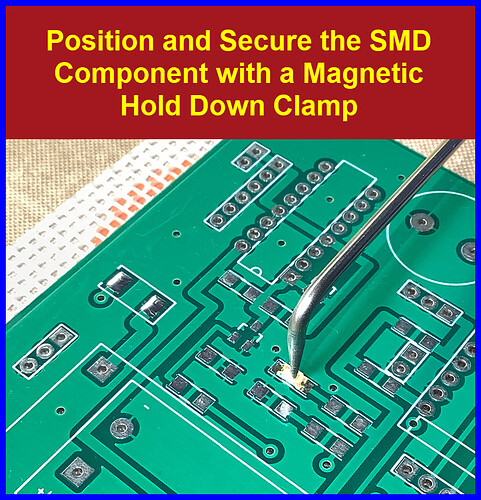
I'd like to dip my toe into the SMD realm with this kit:
I have on hand my Weller TC201 PTA7 with .032" x .062" 700°F tip, .031" 60/40 rosin core solder, a tin of rosin flux, and the usual hand tools suitable for thru-hole devices.
What additional gear would I need to have a chance of success at this?
Why: I came upon this little item a while back and just wanted to experiment with it.
In addition I have a small oven, there are tutorials on how to make them if you do not want to purchase one. It is handy when doing many boards. I also have a solder dispenser, again a big help. Compressed air is handy especially for the solder dispenser. I purchased a small compressor that is very quiet. You do not need any of this but over time it will help.
I also have several pairs of reading glasses, 4,6 and 8 Power. I purchased the inexpensive ones as they are only used on the bench. I use my wife's old ultrasonic cleaner, with Isopropyl but you must keep it in a well ventilated area when using as it is a fire hazard.
If you advance to solder paste, you will need to thoroughly wash and clean the board when you are through. Solder paste contains flux with organic acids that are activated by the soldering heat. They are still active on the circuit board when you are through soldering. Hot water and a thorough scrubbing with a tooth brush are required to remove all the flux and loose solder particles.
Just to give you my opinion, I historically have had the support of a technician with much more skill and practice than me. However, usually on a late night working on urgent product development I have de-soldered and resoldered passives and a few active devices.
I have soldered 0805 passives without much issue using just a fine tip on a soldering iron and my own eyes - one small benefit of being very shortsighted. My home prototyping stuff is 0805 to make my life easier.
I have soldered 0603 OK but struggled with 0402. I made a mess of 0201 and even struggled to see 01005 let alone solder. To aid viewing I have used microscopes, ones with a screen I found very good. Most of the work I have done has used magnifying glasses or eyepieces. I nearly alway use a soldering iron or a hot air gun; especially for desoldering.
I have worked with technicians who happily solder TSOPs and other fine pitch components, not reliable for me as an occasional solderer, I've got there eventually but a bit messy.
Hope this helps a bit. It hopefully goes to show that some work can be done with simple kit. Always nicer with more sophisticated kit - for me usually a client's set up.
Down to 0603 size I can do with decent strong reading glasses, No6 min and a standard Yihua soldering iron with the pointy copper non-steel coated bits (cheap).
A 858D hot air blower (cheap) is good for removing stuff and if forced to do the smaller QFN components I use a hot plate, but that did not cost much either.
I have a head-worn magnifier that's OK for board inspection, and I still have to wear my spectacles, but the working distance is just too close. I got by for a long time with a Luxo magnifier, but presbyopia has won out.
Since my company was in the commercial circuit board business, we use de-ionized compressed air to blow water and debris out from under components. Also used a commercial circuit board washer, but had a regular everyday dishwasher for backup.
You can use regular compressed air in an emergency.